
Home · Blog · Starting solids
First Foods for Baby: A Simple Starter List for Around 6 Months
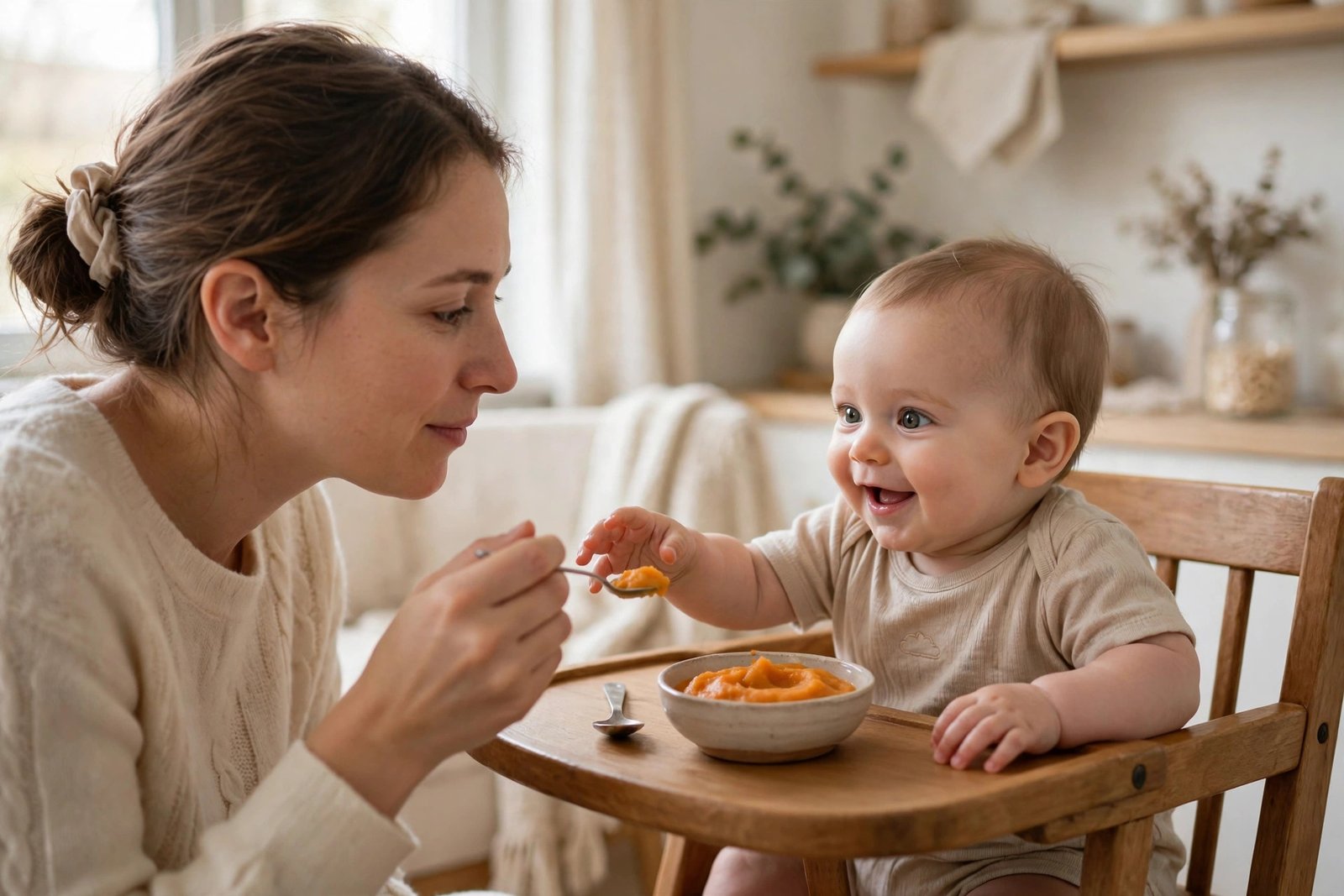
Around 6 months, milk stops being quite enough on its own — your baby's iron stores start to run low, and a spoonful of food joins the menu. The good news: there is no single "correct" first food. The AAP says the order is your choice. What matters is starting with iron, one food at a time, and keeping it soft and simple.
If you are not sure your baby is ready yet, start with our guide to the 3 signs that matter — this list assumes those signs are already there. Everything below follows the AAP and CDC guidance as of November 2026, and it is general education, not medical advice for your individual baby. If your baby was born early or has a health condition, your pediatrician is the right person to ask first.
The starter list at a glance
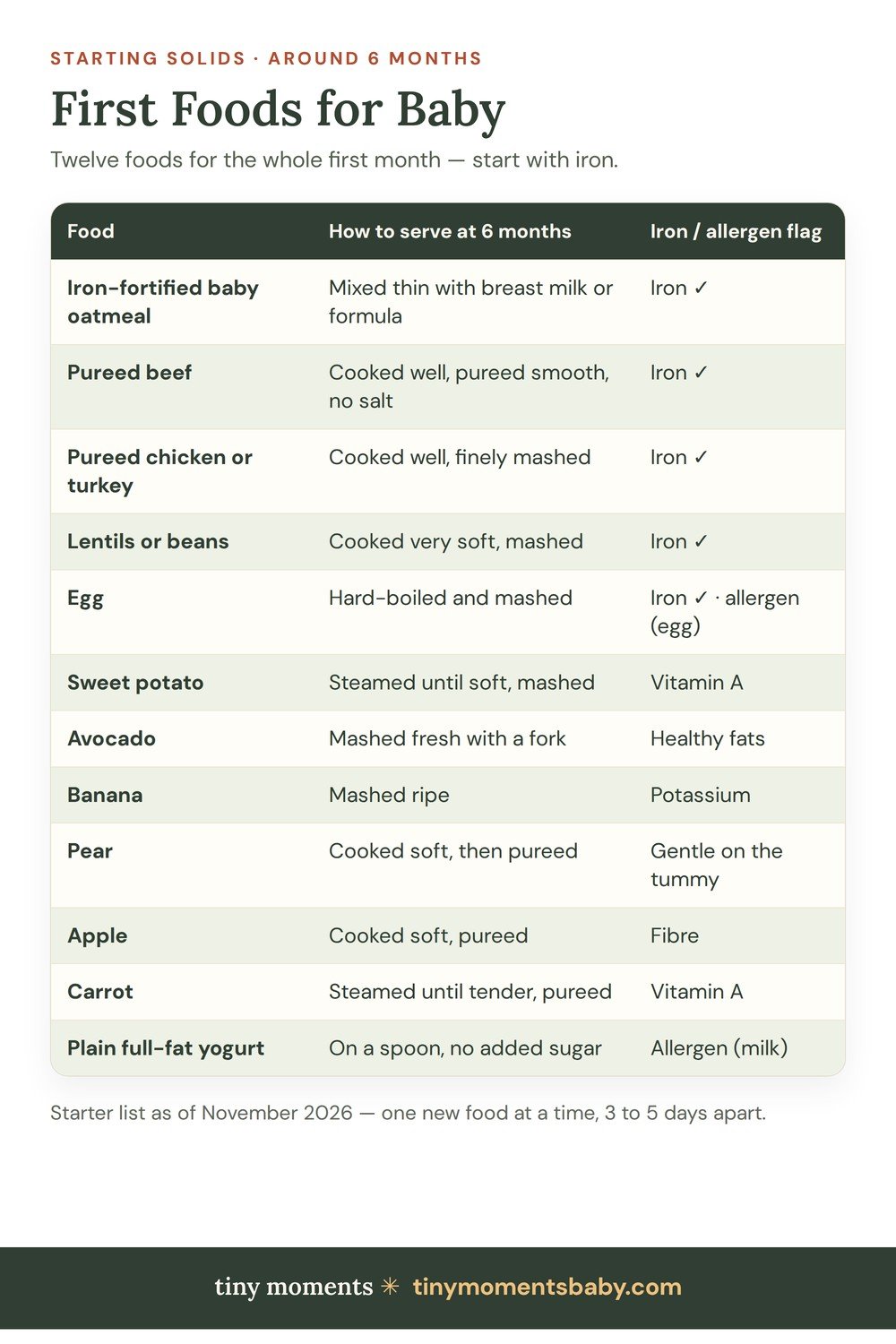
Twelve foods cover the whole first month. The first five carry iron — start there. The rest are the soft fruits and vegetables that round the week out. Every one of them is a single ingredient, served smooth, with nothing added.
| Food | How to serve at 6 months | Iron / allergen flag |
|---|---|---|
| Iron-fortified baby oatmeal | Mixed thin with breast milk or formula | Iron ✓ |
| Pureed beef | Cooked well, pureed smooth, no salt | Iron ✓ |
| Pureed chicken or turkey | Cooked well, finely mashed | Iron ✓ |
| Lentils or beans | Cooked very soft, mashed | Iron ✓ |
| Egg | Hard-boiled and mashed | Iron ✓ · allergen (egg) |
| Sweet potato | Steamed until soft, mashed | Vitamin A |
| Avocado | Mashed fresh with a fork | Healthy fats |
| Banana | Mashed ripe | Potassium |
| Pear | Cooked soft, then pureed | Gentle on the tummy |
| Apple | Cooked soft, pureed | Fibre |
| Carrot | Steamed until tender, pureed | Vitamin A |
| Plain full-fat yogurt | On a spoon, no added sugar | Allergen (milk) |
Swipe sideways to see the full chart →
Starter list as of November 2026, from AAP and CDC guidance.
A note on rice cereal: it used to be the default first food, and it is still fine — but it should not be the only cereal. The CDC says to offer a variety of fortified infant cereals such as oat, barley, and multigrain instead of only rice cereal, because feeding only rice cereal can increase your child's risk of arsenic exposure. Oatmeal is the simplest swap: same spoon, more variety.
How much, and how often
Less than most parents expect — and that is normal. The first spoonfuls are practice, not meals. The AAP suggests starting with half a spoonful or less, then building to a teaspoonful or two. The CDC's version is the same idea in bigger units: give 1 or 2 tablespoons of food per meal, and watch for signs your baby is still hungry or full.
A realistic first month looks like this:
- Week 1–2: one small taste a day — half a spoonful to a couple of teaspoons, once a day, after a milk feed when your baby is alert but not starving.
- Week 3–4: 1–2 tablespoons, once or twice a day. Some days your baby eats three spoonfuls, some days none — both are fine.
- By 7–8 months: two to three small meals a day, with a wider mix of food groups.
Milk does not step aside. The AAP is clear that starting solids is a gradual process and that at first your baby still gets most of their nutrition from breast milk, formula, or both. Offer the milk feed first (or finish with it), and let solids be the small extra — not the other way round. If your baby turns their head away or pushes the spoon out, the meal is over. Stopping when they say stop is part of learning to eat.
Keep the first month on your fridge
The free Tiny Moments Starter Pack has the printable first-foods list and the milestone pages to record the messy first spoonfuls.
Get the free starter pack →A first week on the spoon
One new food at a time, with 3 to 5 days between each new one — that is the CDC's rule, and it exists so you can tell which food caused a reaction if one appears. So a first week is not seven new foods; it is two or three, repeated until your baby knows them.
| Days | New food | How to serve | What to watch |
|---|---|---|---|
| Day 1–3 | Iron-fortified baby oatmeal | Mixed thin with breast milk or formula, half a spoonful at a time | Any rash, vomiting, or unusual fussiness within a day |
| Day 4–6 | Sweet potato | Steamed and mashed smooth; keep the oatmeal going too | Same — one new food means one clear suspect |
| Day 7 | Avocado | Mashed fresh with a fork | By now your baby knows the routine: spoon, taste, pause |
Swipe sideways to see the full chart →
After that first week, keep the same rhythm: a new food every 3 to 5 days, iron foods in the mix every day, and the foods your baby already knows repeated alongside the new one. By the end of the first month most babies have tried six to eight foods — and the "menu" is really just a rotation of the twelve on the list above. If your baby refuses a food, wait a week and offer it again; it often takes several tries before a new taste is accepted.
Picking your baby's first food: a 4-point check
There are three common ways families start, and they are not equal. The comparison below is the honest version — most guides quietly pick one without saying why.
| Way to start | First food | Iron in week 1? | Allergy watch | Ease |
|---|---|---|---|---|
| Iron-first (our pick) | Iron-fortified oatmeal or pureed meat | Yes — from day one | Same 3–5 day rule as any new food | Easy: one pot, one spoon |
| Fruit-first | Banana or avocado | No — iron waits for week 2–3 | Same 3–5 day rule | Easiest: no cooking at all |
| Rice-cereal-only | Infant rice cereal, every day | Yes, but only one source | Same 3–5 day rule | Easy — but the CDC advises varying cereals |
Swipe sideways to see the full chart →
Whichever route you choose, run it through this 4-point check before the first spoonful:
- Iron in the first week? Your baby's iron stores begin to diminish at about 6 months, so an iron food should appear in the first few days — oatmeal, meat, lentils, or egg — not "sometime later".
- One ingredient only? A single food, so a reaction has one clear cause. No mixed jars, no two new foods on the same day.
- Soft and smooth? Mashed, pureed, or strained to a texture that drips slowly off the spoon. Hard pieces, whole grapes, and whole nuts have no place on this spoon.
- Is the allergen plan set? Know which allergens you will introduce in the coming weeks (egg, peanut) and how you will serve them safely — the next section covers that.
If a first food passes all four, it is a good first food — whether it is oatmeal, sweet potato, or avocado. If it fails the iron check, it can still be a great second food.
What to skip before the first birthday
Most foods are fine from around 6 months. The short list below is not — and the reasons are worth knowing, because they explain why the rules are absolute rather than cautious.
- Honey, in any form — including honey baked into food. The NHS says honey should be completely avoided until your baby is 12 months old, because it contains bacteria that can lead to infant botulism, which can make your baby seriously unwell.
- Cow's milk as a main drink — the CDC says drinking cow's milk is not recommended until your child is older than 12 months. It is fine in cooking, and yogurt and cheese are fine from 6 months; it is the drink, not the dairy, that waits.
- Fruit juice, even 100% juice — no benefit before 1, and a fast track to a sweet tooth and tooth decay. Whole fruit, mashed or cut small, is the better version of the same flavour.
- Added salt and sugar — babies do not need either, and salt is hard on small kidneys. Take your baby's portion out before you season the family food.
- Choking shapes, served whole — whole nuts, whole grapes, popcorn, hard raw vegetables, and spoonfuls of thick nut butter. Cut round foods into small pieces; the CDC's example is grapes, cherries, berries, and tomatoes, cut small.
One more quiet trap from the forums: rice-based baby foods and heavy metals. Parents on Quora ask about it for good reason — rice can carry more arsenic than other grains. The practical answer is the CDC's: vary the cereals (oat, barley, multigrain), do not feed rice cereal alone, and do not panic about a single bowl.
Allergens: start early, start small
Old advice said to delay egg, peanut, and fish. Current guidance says the opposite. The AAP states there is no evidence that waiting to introduce baby-safe foods such as eggs, dairy, soy, peanut products, or fish beyond 4 to 6 months of age prevents food allergy — and newer research suggests early introduction may actually help prevent allergy.
How to do it, once your baby has eaten a few other foods:
- Egg: well cooked — scrambled or hard-boiled until firm, then mashed. About a third of a well-cooked egg is a sensible first portion.
- Peanut: smooth peanut butter thinned with breast milk, formula, or puree until runny — never a spoonful of thick peanut butter, and never whole or chopped nuts, which are choking hazards.
- Keep them in the diet: once an allergen is tolerated, offer it regularly — a couple of times a week — rather than once and never again.
- One at a time: the same 3–5 day rule, so you know which food did what.
The exception: if your baby has severe eczema or has already had an immediate allergic reaction to a food — especially egg — talk with your pediatrician first about how and when to introduce the highly allergenic foods. That conversation is worth having before the first taste, not after a reaction.
Questions parents ask us
What is the best first food for a 6-month-old baby?
There is no single best first food — the AAP says the order is your choice. Lead with iron, because your baby's iron stores begin to diminish at about 6 months: iron-fortified baby oatmeal, pureed meat, lentils, or egg are all strong first choices. Soft fruits and vegetables like sweet potato, avocado, and banana can follow in the same first week, one new food at a time.
How much solid food should a 6 month old eat per day?
Very little at first. The AAP suggests starting with half a spoonful or less, then building to a teaspoonful or two; the CDC suggests giving 1 or 2 tablespoons of food per meal. Offer solids once or twice a day in the first weeks, and let your baby's hunger cues lead — milk stays the main source of nutrition until 12 months.
When can babies eat eggs and peanut butter?
Around 6 months, once your baby has eaten a few other foods — and not before 4 months. There is no evidence that waiting to introduce baby-safe foods such as eggs, dairy, soy, peanut products, or fish beyond 4 to 6 months prevents food allergy. Serve egg well cooked and peanut only as smooth peanut butter thinned with milk or puree — never whole nuts or spoonfuls of thick peanut butter. If your baby has severe eczema or an egg allergy, ask your pediatrician first.
What foods should you avoid for babies under 1?
Honey in any form (it can carry the bacteria that cause infant botulism), cow's milk as a main drink, fruit juice, and added salt or sugar. Also avoid choking-shaped foods served whole: whole nuts, whole grapes, popcorn, and hard raw vegetables — cut round foods into small pieces. Cow's milk is fine in cooking, and yogurt and cheese are fine from 6 months.
Want the whole first year, not just the first spoonful?
The Complete Kit is the full Tiny Moments set: the milestone chart, the memory book pages, the milestone cards, and the keepsake pages for baby's first year — printable, fridge-friendly, and made to be filled in at 2 a.m. as easily as at noon.
$9.99
See the Complete Kit →Written by Sahinul Islam Laskar, founder of Tiny Moments
Sahinul runs Tiny Moments, a small independent studio making calm, practical printables and guides for new parents. He is not a medical professional: everything here is educational information drawn from published guidance (AAP, CDC) and official data (SSA) — never a substitute for your paediatrician's advice.
Keep reading
 Starting SolidsSigns Your Baby Is Ready for Solids: The 3 Signs That MatterAround 6 months, plus three signs that must appear together — the calm, consensus guide to knowing your baby is ready for first foods.
 Baby SleepNap Transitions: When Babies Drop from 3 Naps to 2Most babies drop from 3 naps to 2 between 6 and 9 months. A 7-day nap log, a 3-question readiness test and a 3-day trial — decide with data, not guesswork.
 Baby NamesSouthern Baby Names: Sweet Classics & Cowgirl PicksForty Southern names — sweet classics and cowgirl picks — with meanings, pronunciations and honest US popularity, plus a lane-choosing guide.
 Baby NamesDutch Baby Names & Meanings: Short, Strong PicksForty short, strong Dutch names — 3 to 6 letters each — with meanings, pronunciations and honest US popularity, plus a 3-step shortlist.
 Baby NamesRare Baby Names That Are Still Easy to WearForty rare baby names that are still easy to wear — with meanings, pronunciations and honest US popularity, plus a 5-second test for choosing together.
Swipe sideways for more →
Sources & further reading: CDC — When, What, and How to Introduce Solid Foods · AAP HealthyChildren — Starting Solid Foods · AAP HealthyChildren — When to Introduce Egg, Peanut Butter & Other Common Food Allergens · NHS — Foods to Avoid Giving Babies
Educational information only, not medical advice.