
Home · Blog · Baby sleep
Why Is My Baby Waking Up Early? Fixing 5–6 AM Wakings

If your baby is up at 5 a.m. most mornings — wide awake while the house is still dark — you are not alone, and you are probably not doing anything wrong. The last hours of the night are the lightest, most fragile part of a baby's sleep, so a small thing that would not wake them at midnight wakes them fully at 5. This guide helps you find which small thing it is, and what to change first.
What counts as waking up too early?
Before you fix anything, check whether the wake is actually early. Most sleep experts draw the line at 6:00 a.m.: a regular wake before 6 is an early waking, and a wake between 6:00 and 7:30 a.m. is a healthy, normal morning for most babies. For babies under 12 months, anything before 5 a.m. is usually a true night waking rather than a morning rise — the night is simply not finished yet.
There is one check that catches a lot of parents out. Work out the length of the night: bedtime to wake time. If your baby goes down at 6:30 p.m. and wakes at 5:00 a.m., that is a 10-and-a-half-hour night — a perfectly reasonable length of sleep, just positioned early. In that case the wake is not a problem to fix; the whole schedule is sitting early, and the fix is to shift bedtime later by 15 minutes every three days, not earlier.
And one bad morning is noise. A wake that happens once after a vaccination, a hot night, or a day of travel tells you nothing. Three early wakes in seven days is data — that is the pattern worth fixing. So before changing anything, log five to seven mornings: bedtime, wake time, nap times, and how your baby seemed at the wake. The pattern in that log is what the diagnostic in the next sections reads.
Why 5 a.m. is the hardest hour to fix
Early morning is not just "the end of the night". Biologically, it is a completely different sleep environment from the first half of the night — and that is why 5 a.m. wakes are the most stubborn sleep problem parents face.
- Deep sleep is mostly banked. The deep, restorative stages of sleep happen mostly in the first half of the night. By 4 or 5 a.m., your baby is cycling through lighter, REM-dominant sleep, and it takes very little to wake them fully.
- Sleep pressure is nearly spent. The drive to sleep that pulled your baby into deep sleep at 7 p.m. is almost used up by 5 a.m. There is simply less biological force holding them asleep.
- Cortisol is rising. The body's wake-up hormone starts climbing in the final hours of sleep, ahead of its morning peak. A brief arousal at 5 a.m. that would have passed unnoticed at midnight rides that rising curve into a full wake.
- Sleep cycles are short. A baby's sleep cycle lasts roughly 45–50 minutes, and every cycle ends with a brief, lighter moment. In the early morning those moments are lighter still, so a small disruption — a sliver of light, a cold room, a bird — can end the night.
That window is biological. You cannot move it. What you can move is everything around it: how much sleep pressure is left by 5 a.m., how dark the room is, how hungry your baby is, and whether yesterday's schedule drained the tank too early. That is what the rest of this guide does.
One age note: the American Academy of Pediatrics notes that babies do not have regular sleep cycles until about 4 months of age. Before that, early wakes are usually feeding cues, not a schedule problem — a newborn who wakes at 5 a.m. hungry is doing exactly what newborns do. The diagnostic below is written for babies from about 4 months onward.
Find your cause: the wake-pattern diagnostic
Every guide lists the same causes. The hard part is knowing which one is yours. Read down the left column, find the morning that looks like yours, and that row gives you the likely cause — and the single fix to try first. Change that one thing only, and give it 5–7 days before judging it.
| What the mornings look like | Likely cause | First fix to try |
|---|---|---|
| Same time most mornings, baby happy and chatty | Habit — the body clock is set | Keep it dark and boring until 6 a.m. |
| Wakes crying, hard to settle, cranky all day | Overtired — bedtime too late | Move bedtime 15 minutes earlier |
| Wakes happy, plays in the crib, wide awake | Not tired — too much day sleep | Cap the longest nap by 15 minutes |
| Wakes as the room brightens | Light leak at dawn | Black out the room properly |
| Wakes hungry, feeds well, settles after | Hunger (mainly 4–5 or 8–10 months) | Check daytime feeds first |
| Wakes at a different time each day | Schedule drift — naps moving | Anchor the first nap to a fixed time |
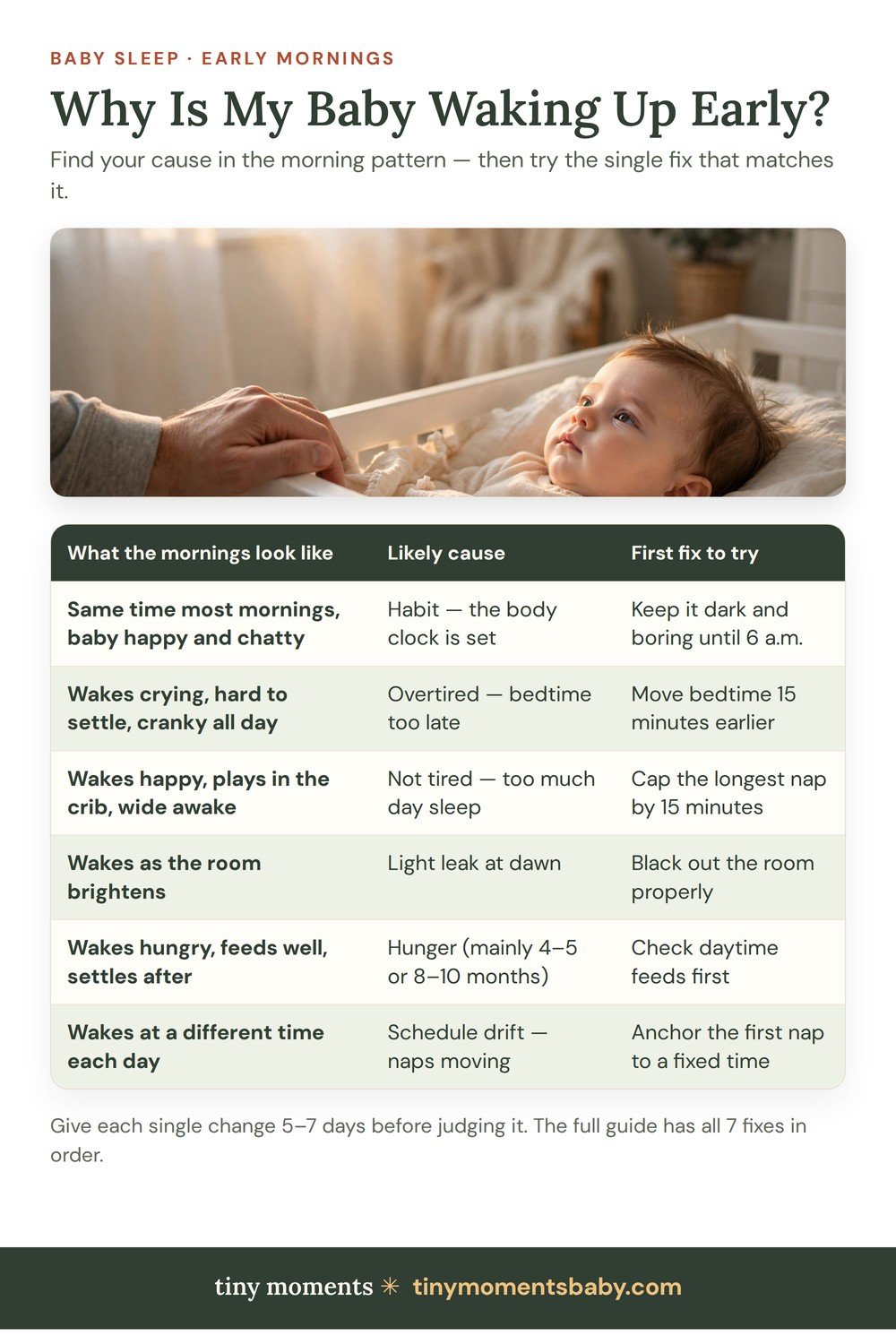
Swipe sideways to see the full chart →
Chart data: November 2026 — causes and fixes cross-checked against the guides listed in Sources below.
Before you change anything, check these three numbers against your log — they are the decision checklist for this guide:
- Total sleep in 24 hours. Add night sleep and all naps. The AASM guidance the AAP endorses is 14–17 hours under 3 months, 12–16 hours at 4–12 months, and 11–14 hours at 1–2 years. Well above the range points to too much day sleep; well below points to overtiredness.
- Night length. Bedtime to wake time. A 10–11 hour night ending at 5 a.m. means the schedule is early, not broken — shift it later. A 9-hour night ending at 5 a.m. means the night is too short — look at bedtime and naps.
- First nap time. If the first nap has drifted earlier and earlier, it is probably reinforcing the early wake — the nap is where the missed night sleep is being caught up.
If two rows of the table seem to fit, start with the cheapest fix: the room. Blackout is a one-evening job, and it rules out the single most common cause before you touch the schedule at all.
The 7 fixes, in the order to try them
Try these one at a time, in this order. Give each one 5–7 days before judging whether it worked — a single good morning is not a fix, and a single bad morning is not a failure.
1. Black out the room properly
Light is the single most common cause, especially in spring and summer. Even a thin strip of dawn light at 5 a.m. suppresses melatonin and tells the brain it is morning. Do the hand test at 5 a.m.: walk into the room and hold your hand in front of your face. If you can see it, the room is not dark enough. Tape cardboard over the edges of the blackout curtain if dawn is leaking in, and check with your own eyes at 5 a.m. — a room that is dark at 10 p.m. in winter is often bright at 5 a.m. in May. Cover glowing electronics, and block light from under the door.
2. Move bedtime 15 minutes earlier
This is the counterintuitive one, and it is the fix most parents resist. A later bedtime does not buy a later wake — an overtired baby produces more cortisol, which makes sleep lighter in the second half of the night and pulls the wake earlier. Try 15 minutes earlier for three or four nights, then another 15 if the wake is still early. For most babies aged 3–12 months, a bedtime between 6:30 and 7:30 p.m. works well; many families find a 6:00–6:30 p.m. bedtime leads to a 6:00–7:00 a.m. wake, while a 7:30–8:00 p.m. bedtime leads to a 5:00–5:30 a.m. one. See Baby Sleep Schedule by Age for bedtime windows at every age.
3. End the last nap by 4:30 p.m.
A late-afternoon nap that runs long — or ends too close to bedtime — robs sleep pressure from the front of the night, and the back of the night pays for it by ending early. For a 5-to-9-month-old, the last nap should end by about 4:30 p.m. If it regularly runs past that, wake your baby gently from it; protecting bedtime beats finishing a nap. See Baby Nap Schedule by Age for how naps sit at every stage.
4. Anchor the first nap to a fixed time
If the first nap has drifted earlier and earlier, it is reinforcing the early wake: your baby learns they can catch up on the missed night sleep at the morning nap. Hold the first nap at a fixed time for 5–7 days and watch what the wake time does. The usual anchors are not before 8:00 a.m. on three naps, 9:00 a.m. on two naps, and noon on one nap — even after an early waking. The first days feel rough; the anchor is what breaks the drift.
5. Cap total day sleep
There is only so much sleep in 24 hours. If your baby is banking too many hours during the day, those hours get subtracted from the night — and the subtraction usually comes off the morning end. Most babies aged 6–12 months need roughly 2.5–3.5 hours of daytime sleep. If your baby is consistently above that and waking early, cap the longest nap by 15 minutes and give the change three or four days. Check the ranges against your baby's age in our wake window chart before capping anything.
6. Treat 5 a.m. like a night waking
If your baby has been waking at 5 a.m. for two weeks and you have been starting the day at that time — lights on, feed, chat, play — the body clock has simply shifted, and the morning feed has become the reward that keeps the wake in place. The fix is about what happens at 5 a.m., not about the schedule: keep the room dark, keep your voice low, keep it boring, and save the bright, happy "good morning" for the real wake time. If there is a 5 a.m. feed, delay it by 5–10 minutes a day until it merges into the morning feed. A baby who wakes at 5 but chats quietly and dozes until 6 may still be getting enough rest — that is a different morning from a baby who wakes crying and cannot go back.
7. Check the room temperature
The coldest part of the night is usually 3–4 a.m., and a room that was comfortable at bedtime can be too cold by the early hours. Keep the room between 68–72°F (20–22°C) through the night, and check whether your baby needs an extra layer or a pair of socks for the early hours. Run white noise all night at a steady volume too — it masks the birds, the heating cycle, and the household sounds that arrive with the dawn and can tip a lightly-sleeping baby into a full wake.
One overlap to keep in mind: the 4-month, 8–10 month and 12-month sleep regressions all have early waking as a symptom, and a regression can look exactly like a schedule problem for two or three weeks. If the early wakes started suddenly alongside a new skill — rolling, crawling, pulling to stand — give it the regression's usual 2–6 weeks before you rebuild the schedule around it.
Keep the wake windows on your fridge
The free Wake Window Cheat Sheet puts the 0–6 month wake windows and the sleepy cues on one printable page — the two numbers most of the fixes in this guide come back to.
Get the free cheat sheet →Your 7-day, one-change-at-a-time plan
The most common mistake with early waking is changing everything at once — bedtime, naps, and the room on the same night — and then not knowing what worked. This is the slow version, and it is the one that actually tells you the answer:
- Days 1–2: log, don't change. Write down bedtime, wake time, every nap, and how your baby seemed at the wake. Walk into the room at 5 a.m. and check the light and the temperature with your own eyes.
- Day 3: pick one fix. Use the diagnostic table. If the room is not truly dark, start there. Otherwise start with the row that matches your mornings best.
- Days 3–7: hold it. Change nothing else — not bedtime, not naps, not the room. One change, five days, is the only way to read the result.
- Day 7: judge. If the wake has moved 15 minutes later, hold the change and nudge again if you want more. If nothing moved, try the next fix on the table and repeat.
- Week 2: expect the clock to lag. A full reset of the body clock takes up to two weeks of consistency. Early waking is the slowest sleep problem to fix because the biology of 5 a.m. is working against you — patience here is not a platitude, it is the mechanism.
If the wake is moving later by 10–15 minutes a week, you are winning. Early waking rarely flips in a night; it creeps back, one small shift at a time.
When early waking is not a schedule problem
Most early waking is a schedule or environment story. Call your pediatrician — not a sleep consultant — if you see any of these:
- Your baby snores loudly, gasps, or pauses in breathing during sleep
- Fever, ear-pulling, refusing food, or losing weight alongside the early wakes
- Crying that cannot be soothed for over an hour, or waking screaming and inconsolable
- A sudden change in a baby who used to sleep well, with no schedule or environment change to explain it
- Early wakes that several weeks of consistent changes have not touched at all
- A fever of 100.4°F (38°C) or higher in a baby under 3 months — that is always a call, whatever the sleep looks like
These can point to sleep apnea, reflux, anaemia, ear infections, or other treatable problems, and no amount of blackout curtains will fix those. And if your baby wakes happy and rested before dawn every day, totals in the healthy range, and is thriving — the schedule may simply need to sit later. Shift bedtime 15 minutes later every three days and keep mornings dark until your chosen wake time; the clock will follow, slowly.
Questions parents ask us
What time counts as waking up too early for a baby?
Most sleep experts count anything before 6:00 a.m. on a regular basis as an early waking. A healthy morning wake time for most babies is 6:00–7:30 a.m. For babies under 12 months, anything before 5 a.m. is usually a true night waking rather than a morning rise.
Should I move bedtime earlier or later to fix early waking?
Earlier first, in most cases. An overtired baby produces more cortisol, which makes sleep lighter in the second half of the night and pulls the wake earlier — so moving bedtime 15 minutes earlier often shifts the morning wake later within a few days. The exception: if bedtime is already very early and the night is already 10–11 hours long, the wake is on schedule, and bedtime should move later by 15 minutes every three days instead.
Is my baby waking early because they are hungry?
Sometimes — mainly around 4–5 months during growth spurts, and again around 8–10 months when solids are not yet replacing many calories. Outside those windows, hunger is rarely the cause. If your baby feeds well at the early wake and settles straight back to sleep, check daytime feeds; if they wake happy and wide awake, look at light and the schedule first.
How long does it take to fix early morning wakings?
Most single changes show a result within 5–7 days, and a full reset of the body clock can take up to two weeks of consistency. Change one thing at a time — if you move bedtime, black out the room and change naps all on the same night, you will not know which change worked.
Want the whole plan, not just the 5 a.m. fix?
Wake Windows Made Simple is the full 44-page kit: age-by-age charts up to 24 months, sample schedules for every stage, nap-transition playbooks and the troubleshooting pages for the hard weeks — printable, fridge-friendly, and written for 2 a.m. brains.
$9.99
See Wake Windows Made Simple →Keep reading
 Baby SleepNewborn Sleep Schedule: What the First 8 Weeks Really Look LikeNewborns sleep in short bursts, not schedules. A week-by-week look at weeks 1–8, with two sample days.
 Baby SleepBaby Nap Schedule by Age (0–12 Months): Charts + Sample DaysHow many naps at every age, how long they last, and when the nap drops happen — with a sample day for each stage.
 Baby SleepSleep Regression Ages: Every Regression From 4 Months to 2 YearsThe 4, 8–10 and 12-month, 18-month and 2-year regressions — what causes each one, how long it lasts, and what helps.
 Baby Sleep4-Month Sleep Regression: Signs, How Long It Lasts & Survival TipsWhy sleep falls apart around four months, the signs it's the real thing, and the tips that actually help.
 Baby SleepBaby Sleep Schedule by Age: Month-by-Month Charts (0–12)What a realistic day looks like at every age — wake times, naps and bedtime windows, month by month.
Swipe sideways for more →
Educational information only, not medical advice.
Sources & further reading: Nappi — Early Morning Wakes, Causes and Fixes · KidyGrow — Why Your Baby Wakes Up Too Early (and What Actually Helps) · LunaCradle — Baby Waking at 5am? 5 Fixes That Actually Work · Pampers — Baby Waking Up Too Early · Tiny Sleep Studio — Why Is My Baby Waking Up Too Early? · AAP HealthyChildren — A Parent's Guide to Safe Sleep · HealthyChildren.org (AAP) — Healthy Sleep Habits: How Many Hours Does Your Child Need?