Your baby's sleep cycles have changed — permanently. The broken nights that come with the change are temporary, but “temporary” can mean weeks of waking every hour. This guide is the part no article gives you: a 2 a.m. plan decided in daylight, a triage checklist for telling a regression from teething, a growth spurt or illness, a shift plan so both parents sleep, and a 14-night tracker that shows the pattern — and the progress.
Shown below: real pages from the guide, with sample entries written in — your copies arrive blank, ready for your family.
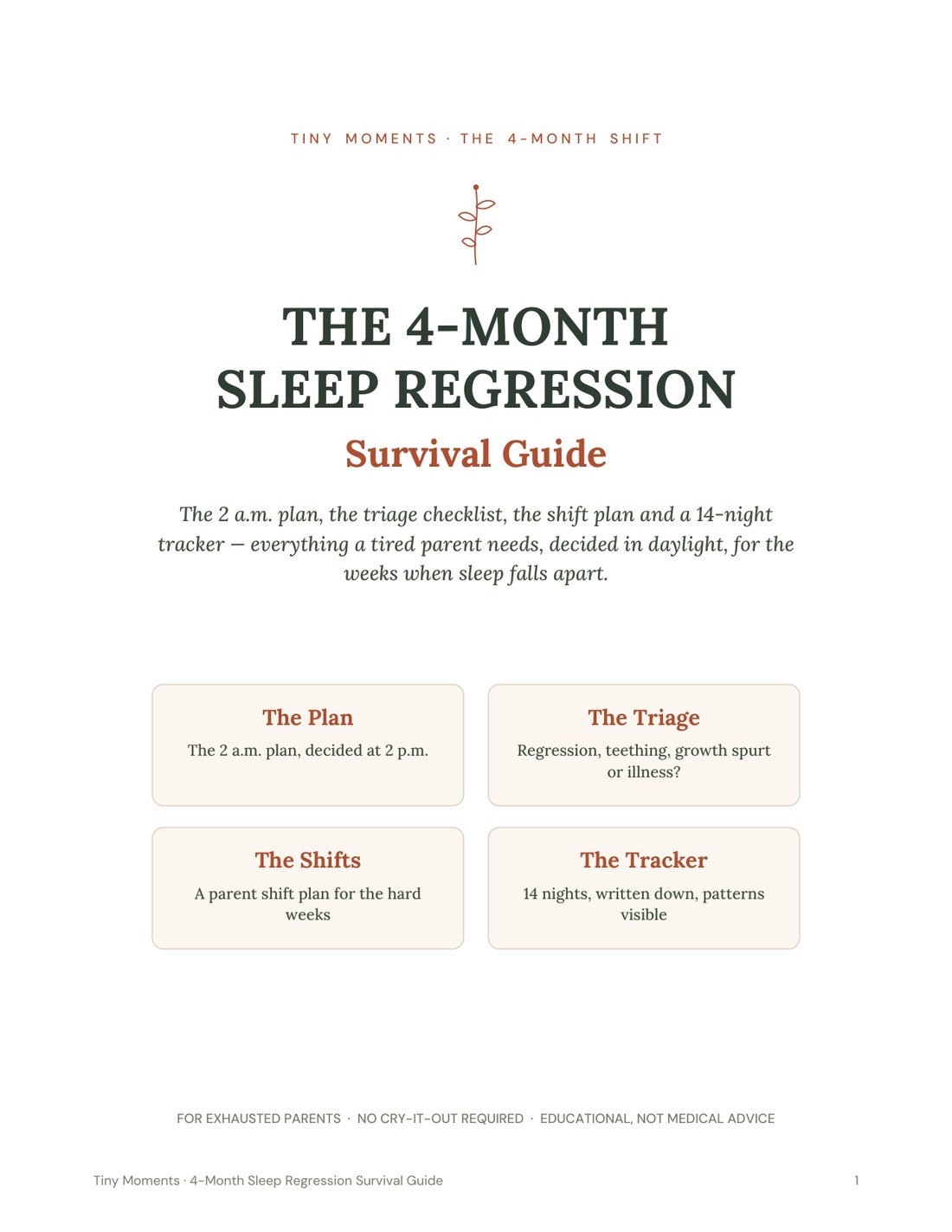
pages — the plan, the chart, the triage
printables for the fridge and the nursery wall
months — when the shift usually starts
red flags that mean “call the pediatrician”
cry-it-out required. Ever.
Sound familiar?
Feed? Rock? Wait? Every waking becomes an argument with yourself in the dark — because nobody decided the plan while they were awake.
The two-hour nap is gone. In its place: one sleep cycle, a bright-eyed baby, and a parent wondering what they broke. (Nothing. The cycles changed.)
Three different problems, three different responses — and they feel identical at 3 a.m. Guessing wrong costs another night.
One adult takes every waking because “it's just easier.” Two to six weeks of that is how parents break. The night needs a schedule, not a hero.
The simple fix
The free articles explain the science — this guide turns it into a system you can run exhausted. One plan for every waking. One checklist for the “is this something else?” nights. One schedule so both parents get a real stretch of sleep. One tracker so two honest weeks — not one terrible night — tell you how it's going.
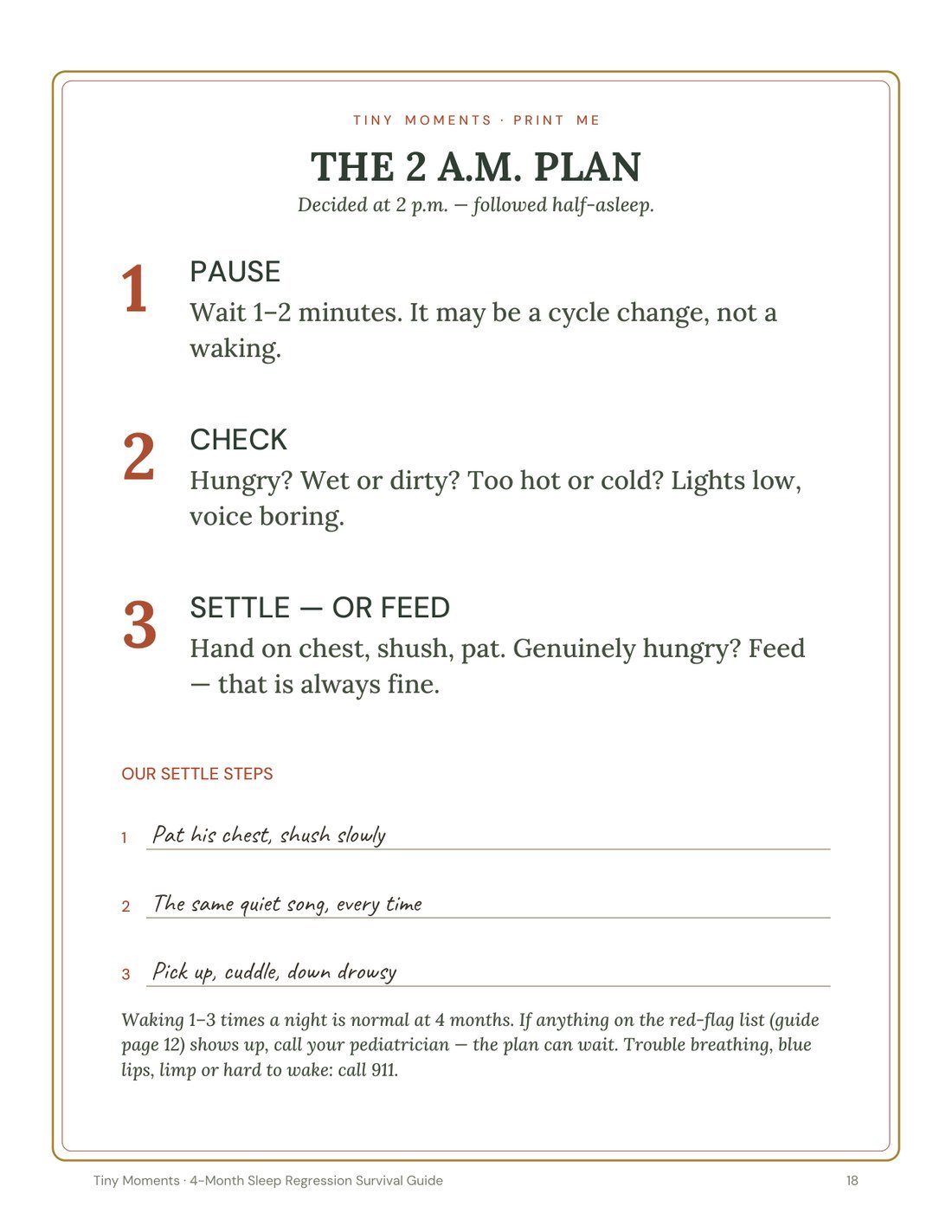
Pause 1–2 minutes → check the basics → settle, or feed
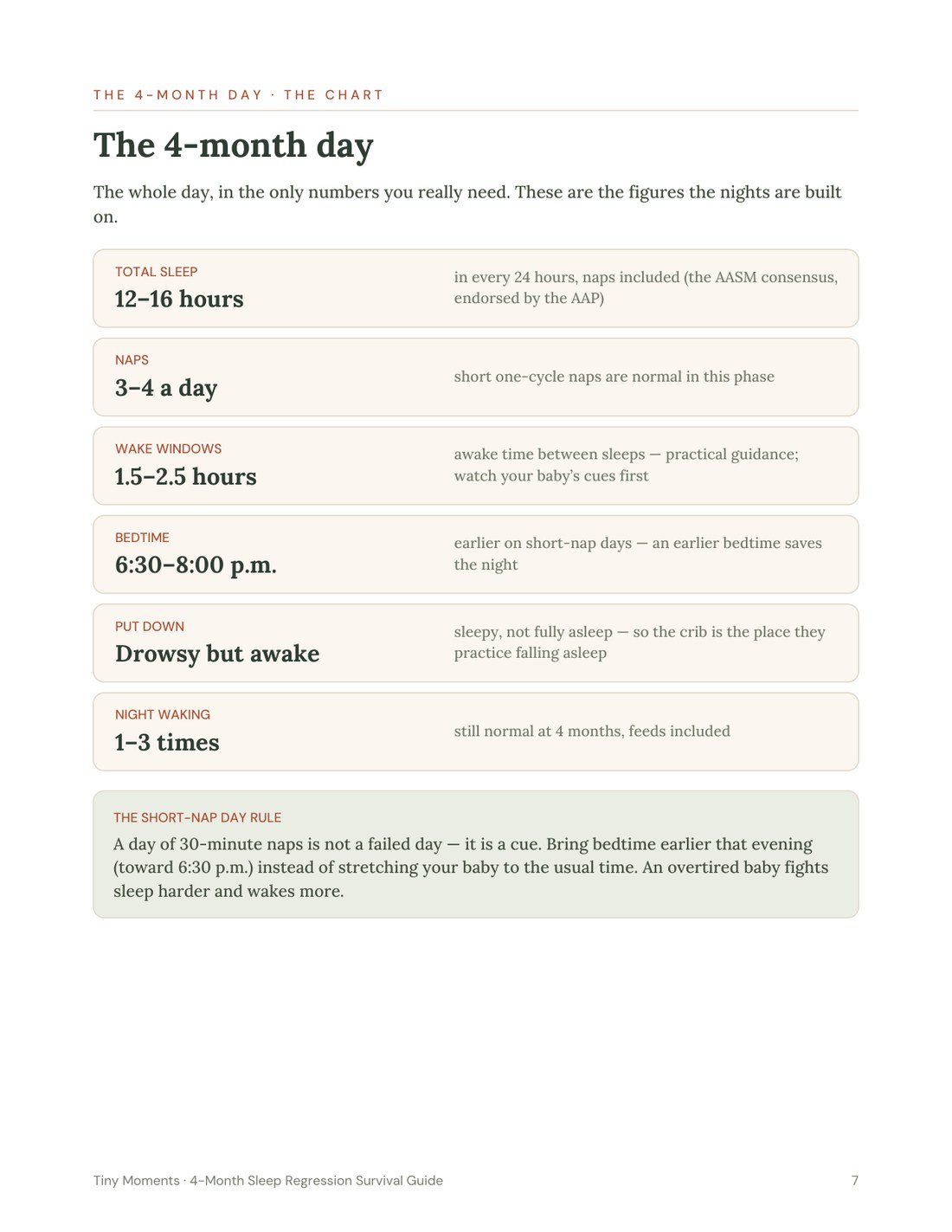
The 4-month day: 12–16 hours, 3–4 naps, wake windows 1.5–2.5 hours
Regression vs teething vs growth spurt vs illness — in one page
AAP safe sleep, the swaddle rule, and the 7 red flags — plus a call-911 list and the parent mental-health hotline
Look inside
These are pages from the actual guide — with sample entries written in, so you can see exactly how a used one looks. Your copies arrive blank.
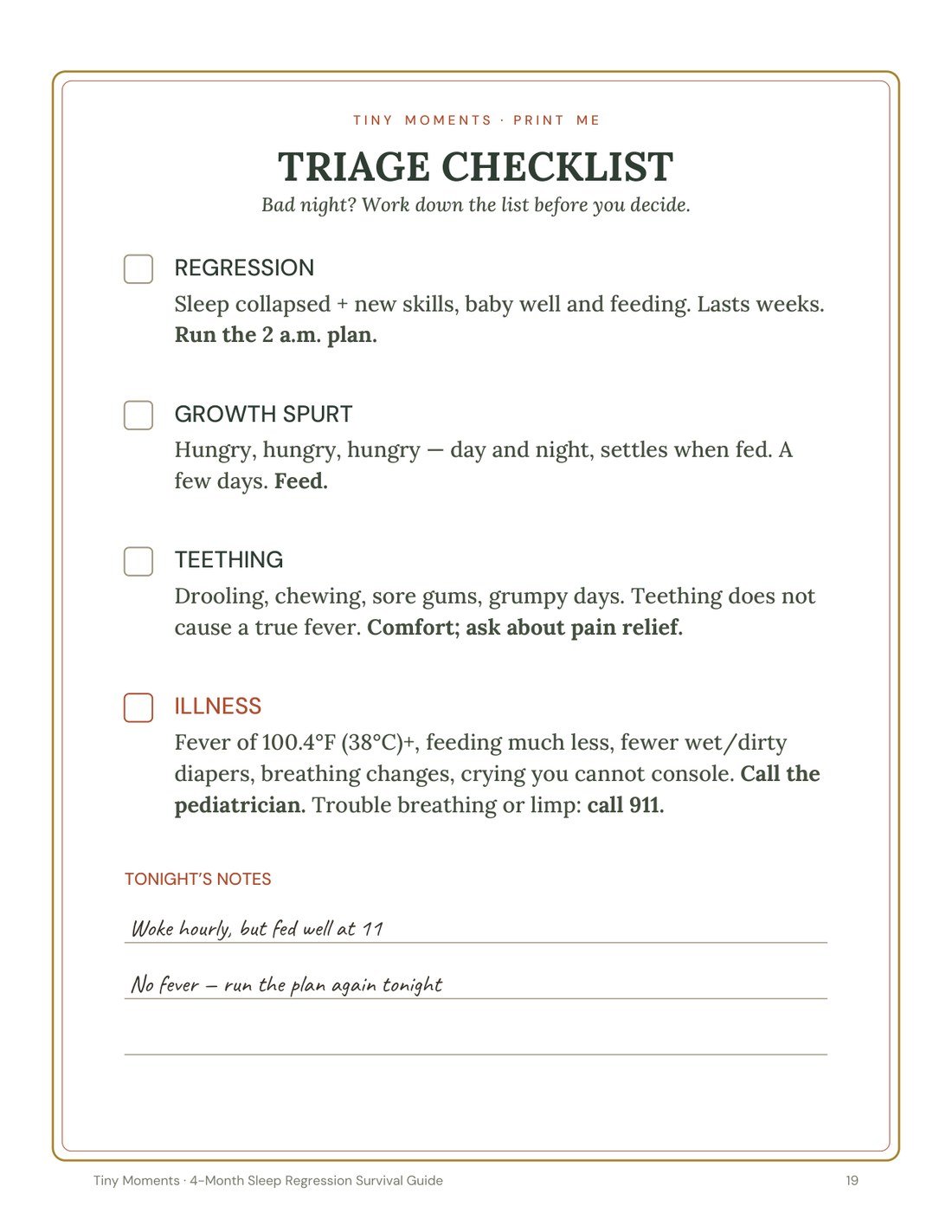
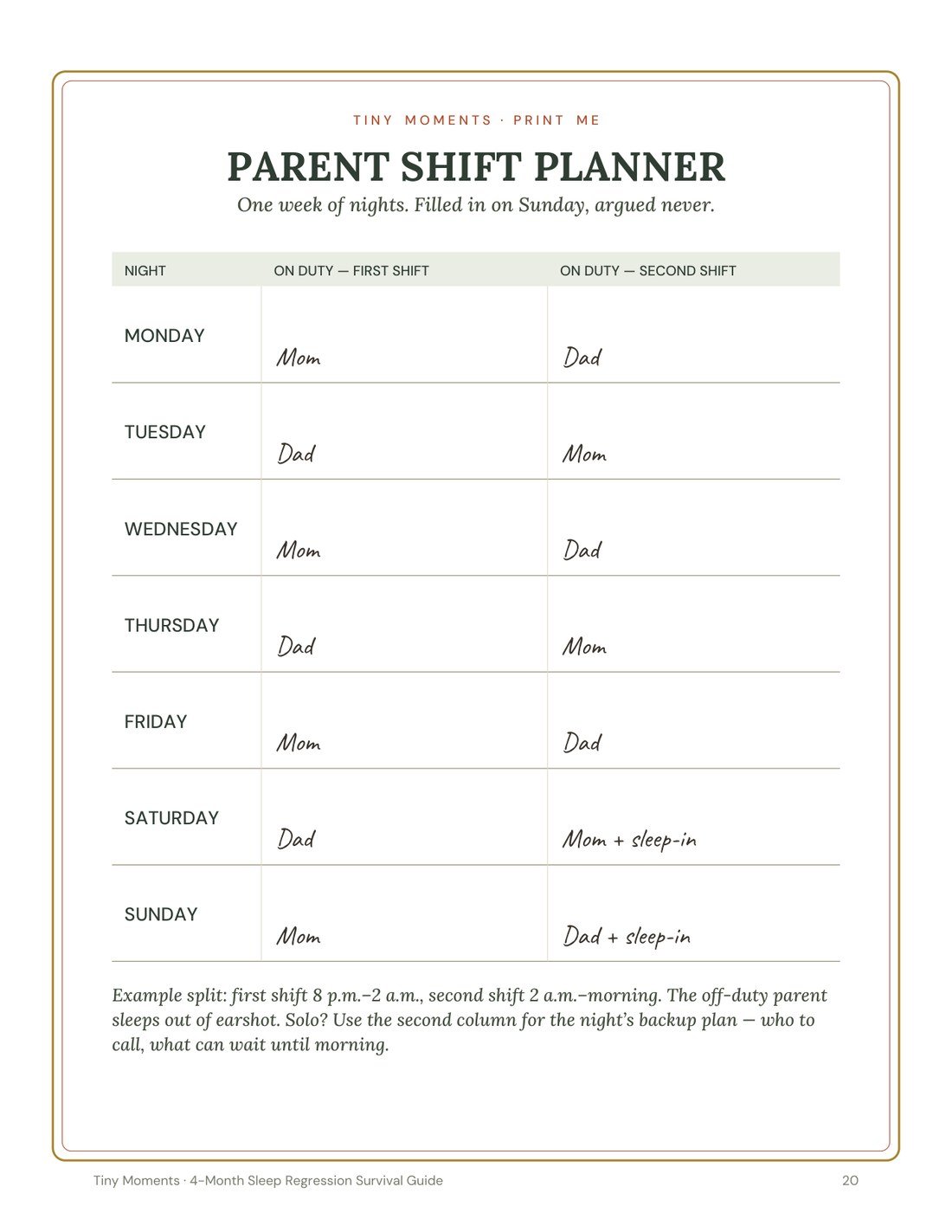
The four printables are full Letter sheets in large type — readable at arm's length, in the dark, one-handed. Print them at 100% and put them where the night happens.
What's inside
Three PDFs in all: the guide in printable and fillable versions, and a one-page start-here — in one ZIP, and every file on its own as well.
When it starts (3.5–5 months), how long the rough patch lasts (about 2–6 weeks), what is permanent (the cycle change) and what is temporary (the broken nights) — the whole guide on one page, for tonight.
Newborn two-stage sleep becomes adult-like light, deep and REM cycles — in plain words, with the seven signs that tell you you're in it (and the reassurance that some babies skip it entirely, which is also normal).
Pause 1–2 minutes → check the basics → settle in the crib, or feed if genuinely hungry. With lines for your own settle steps, so whichever parent goes in does the same thing.
12–16 hours of sleep in 24, 3–4 naps, wake windows of 1.5–2.5 hours, bedtime 6:30–8 p.m., drowsy but awake — plus a sample day drawn with those numbers, and the short-nap-day rule: earlier bedtime, not a later one.
The four things that wreck a 4-month-old's sleep, told apart by what leads them: brain-led and weeks long, hunger-led and days long, gum-led — or the one that means call the pediatrician. (Teething, for the record, does not cause a true fever.)
The parent shift plan and a page on looking after the other patient — you. Then the safety net: the 7 red flags as a numbered list, AAP safe sleep, the swaddle rule (stop at any sign of trying to roll — immediately, regression or not), and optional gentle sleep teaching with no cry-it-out required.
The printables
Full US Letter pages in large type, printed at 100% — or typed into, in the fillable version.
The three steps in the order you'll do them half-asleep, with your family's settle steps written in underneath. Fridge or nursery wall.
Four boxes to work down on the bad night, before you decide anything — plus tonight's-notes lines for what you spotted.
Seven nights, two shifts, both names written down on Sunday. The off-duty parent sleeps out of earshot; nobody negotiates at 3 a.m.
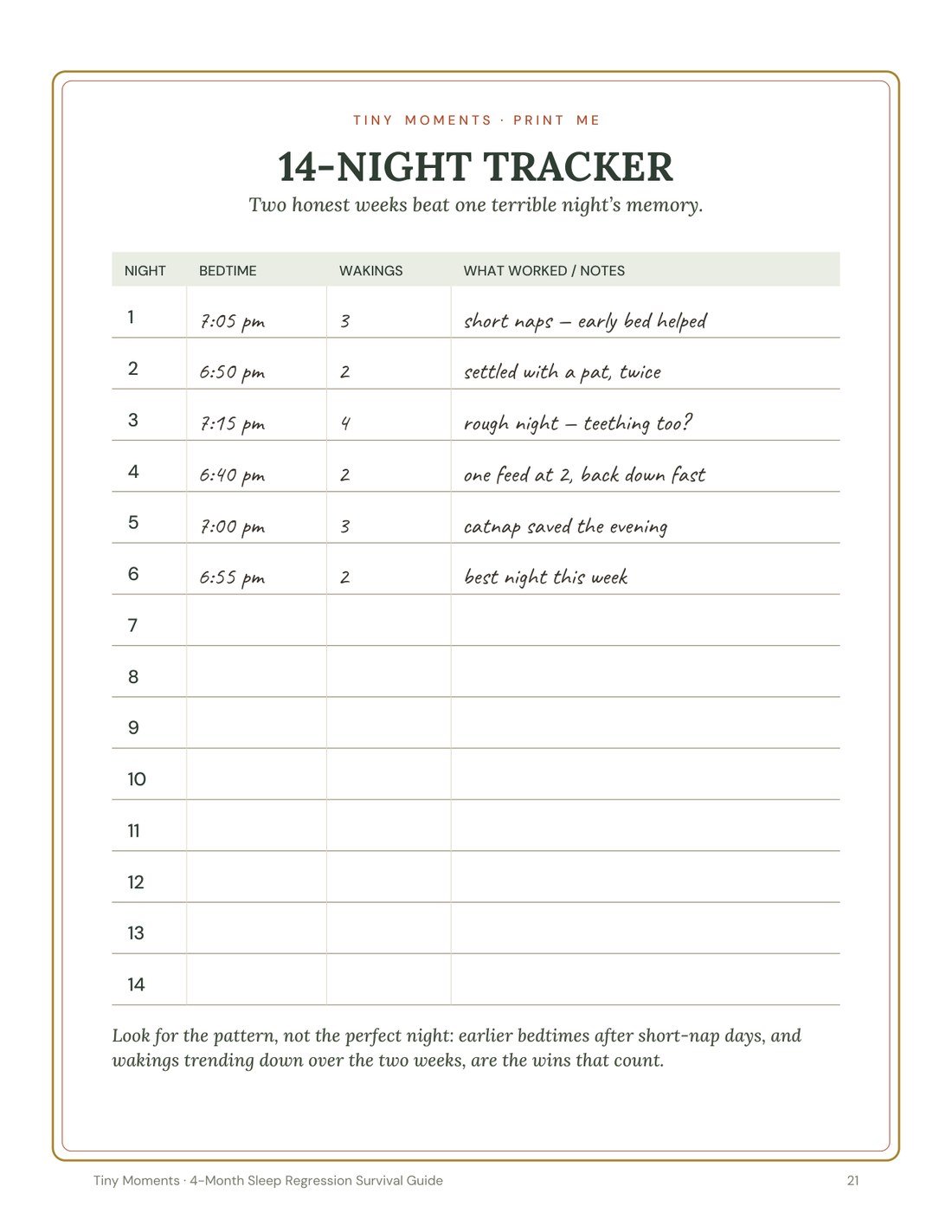
Bedtime, wakings, what worked — fourteen rows. Two honest weeks show the pattern, and the improvement, that no single night reveals.
The details
| Contents | The 22-page guide + 4 printables (inside the guide) + a 1-page start-here |
|---|---|
| Paper size | US Letter throughout — print at 100% (actual size) |
| Forms | Printable (write-in lines) and Fillable (type-in fields on the plan, triage notes, shift planner and tracker) |
| Sources | AAP safe-sleep guidance; AASM sleep-duration consensus endorsed by the AAP; Sleep Foundation; CDC 4-month milestones; KidsHealth |
| Approach | Gentle and responsive — no cry-it-out required, no sleep training required |
| Delivery | Instant download after checkout — ZIP + individual PDFs + start-here page |
How it works
Page 2 (At a glance) and page 6 (The 2 a.m. plan). Ten minutes, one-handed. That is genuinely enough for tonight — the rest is for the morning.
Print the 2 A.M. Plan card (page 18), write in your settle steps, and put it where you feed at night. Fill in the shift planner together tomorrow.
One line a night on the tracker. By night fourteen you'll see what no single night can show you: the pattern, and whether it's bending the right way.
Included free
The whole guide again as a type-in PDF — the settle steps, triage notes, shift planner and all fourteen tracker rows as fields that work in free Adobe Acrobat Reader and most PDF apps. For the parent who'd rather tap than write at 2 a.m. No extra charge, no second product.
One page that maps the download: what to read tonight, what to print first and in what order, the file list, and the refund line — so nothing in the ZIP is a mystery.
Instant download · Yours to keep & reprint for your family
Under $10 — one-time: the whole guide is $9.99. No subscription, no renewals, no course upsell waiting behind it.
The companion guide
This guide is for the rough nights of the 4-month shift. Wake Windows Made Simple is the timing system for the whole first six months — the chart, the sleepy cues, and a gentle 14-night plan that keeps days like these on the rails.

The wake-window chart by age for your fridge, how to read your baby's sleepy cues before the meltdown, and a gentle 14-night plan — the daytime half of the same system, from the same shelf.
$9.99See Wake Windows →
This guide is educational only. It is not medical advice, and it does not replace the care of your pediatrician. If you are worried about your baby's health, feeding, growth or breathing, contact your pediatrician or your local urgent-care service. Wake windows are practical guidance used by pediatric sleep practitioners; they are not an AAP or AASM clinical guideline, and your baby's cues outrank any chart — including ours.
Questions
The 4-Month Sleep Regression Survival Guide is $9.99 — one payment, in US dollars, for everything: the 22-page guide in printable and fillable versions, the four printables, and the start-here page. No subscription, no renewals, nothing more to pay.
No. You pay $9.99 once and the files are yours to keep and reprint for your own family.
Straight after checkout: download buttons appear on your confirmation page, and the same links arrive by email (they work for 30 days — after that, just ask and we will re-send them). You get one tidy ZIP with everything, and each PDF on its own as well.
Twenty-two pages: the at-a-glance summary, why the regression happens (the permanent sleep-cycle change, in plain words), the signs, the 2 a.m. plan, the 4-month day chart (12–16 hours total, 3–4 naps, wake windows of 1.5–2.5 hours, bedtime 6:30–8 p.m.), a sample day, the regression-vs-teething-vs-growth-spurt-vs-illness triage checklist, a parent shift plan and parent care, the 7 red flags for calling the pediatrician, AAP safe sleep with the swaddle rule, optional gentle sleep teaching, FAQs — and the four printables at the back.
Wake Windows is the timing guide for the whole first six months — the chart, the sleepy cues, a gentle 14-night plan. This guide is about one specific disruption: the weeks around 4 months when sleep falls apart. It gives you the pre-decided 2 a.m. plan, the triage checklist, the parent shift schedule and the 14-night tracker. Many parents use both: Wake Windows for the days, this guide for the rough nights.
No. Nothing in this guide requires sleep training, and nothing requires leaving your baby to cry. The gentle-teaching chapter is optional and gradual — drowsy but awake, settling in the crib, fading your help slowly — and the guide says plainly that many babies settle with just the plan, the chart and time.
Honestly: we can't promise your baby's timeline, and any guide that does is guessing. What the evidence says is that for most babies the disruption lasts about 2 to 6 weeks and things generally settle by 5 to 6 months — the sleep-cycle change itself is permanent, the broken nights are not. If there is no improvement at all after about 6 weeks, the guide's red-flag chapter says to check in with your pediatrician.
No. The guide is educational only — it is not medical advice and does not replace your pediatrician. Its safe-sleep chapter follows the American Academy of Pediatrics guidance, its sleep totals are the AASM consensus the AAP endorses, and it includes a clear list of the seven signs that mean “call the pediatrician,” not “read another page.”
Plain US Letter. The four printables at the back of the guide are full Letter sheets in large type, made for the fridge or the nursery wall: the 2 A.M. Plan card, the Triage Checklist, the Parent Shift Planner and the 14-Night Tracker. Print them at 100% (actual size). In the fillable version, the same sheets have type-in fields instead of write-in lines.
Every purchase carries the Tiny Moments promise: tell us within 24 hours of buying and we will refund you in full — no forms, no questions beyond what helps us improve.
The 2 a.m. plan, the triage, the shifts and the tracker — $9.99, in your inbox in minutes.
Get the Survival Guide — $9.99
Instant download · Printable + fillable · Full refund within 24 hours of purchase