
Home · Blog · Milestones & keepsakes
Baby Memory Book Printable: What to Record in Baby's First Year

The first year passes in a blur of night feeds and firsts — and the moments you swore you would never forget are the ones that fade first. A baby memory book is simply a place to catch them: one page a month, one photo, one sentence. This guide gives you the whole first year as a printable plan — what to write each month, a routine that takes ten minutes, and an honest way to choose between a printed book and a digital one.
The month-by-month table: what to write, and when
Read this table as prompts, not deadlines. Every row gives you one thing to watch for and one sentence to finish — and if a skill arrives a month early or a month late, write it down in the month it actually happened. The milestone prompts follow the CDC checklists, and the table is dated November 2026. For the full checkpoint-by-checkpoint picture, see our baby milestones chart for 0–12 months.
| Month | Record this | One-line prompt |
|---|---|---|
| Month 1 | Birth details, first photo | “The day you arrived.” |
| Month 2 | First social smile | “The first time you smiled back…” |
| Month 3 | Head control, cooing | “The sound you make most…” |
| Month 4 | First laugh, grabbing toys | “What made you laugh?” |
| Month 5 | Rolling over, reaching | “You got from A to B by…” |
| Month 6 | Sitting up, first food | “Your face when you tasted…” |
| Month 7 | Babbling, favourite toy | “The sound you say most…” |
| Month 8 | Sitting alone, crawling | “The way you move now…” |
| Month 9 | Pulling up, waving | “You waved at…” |
| Month 10 | First tooth, cruising | “Your newest trick…” |
| Month 11 | First word, standing | “The word you said was…” |
| Month 12 | First steps, first birthday | “One year in, you love…” |
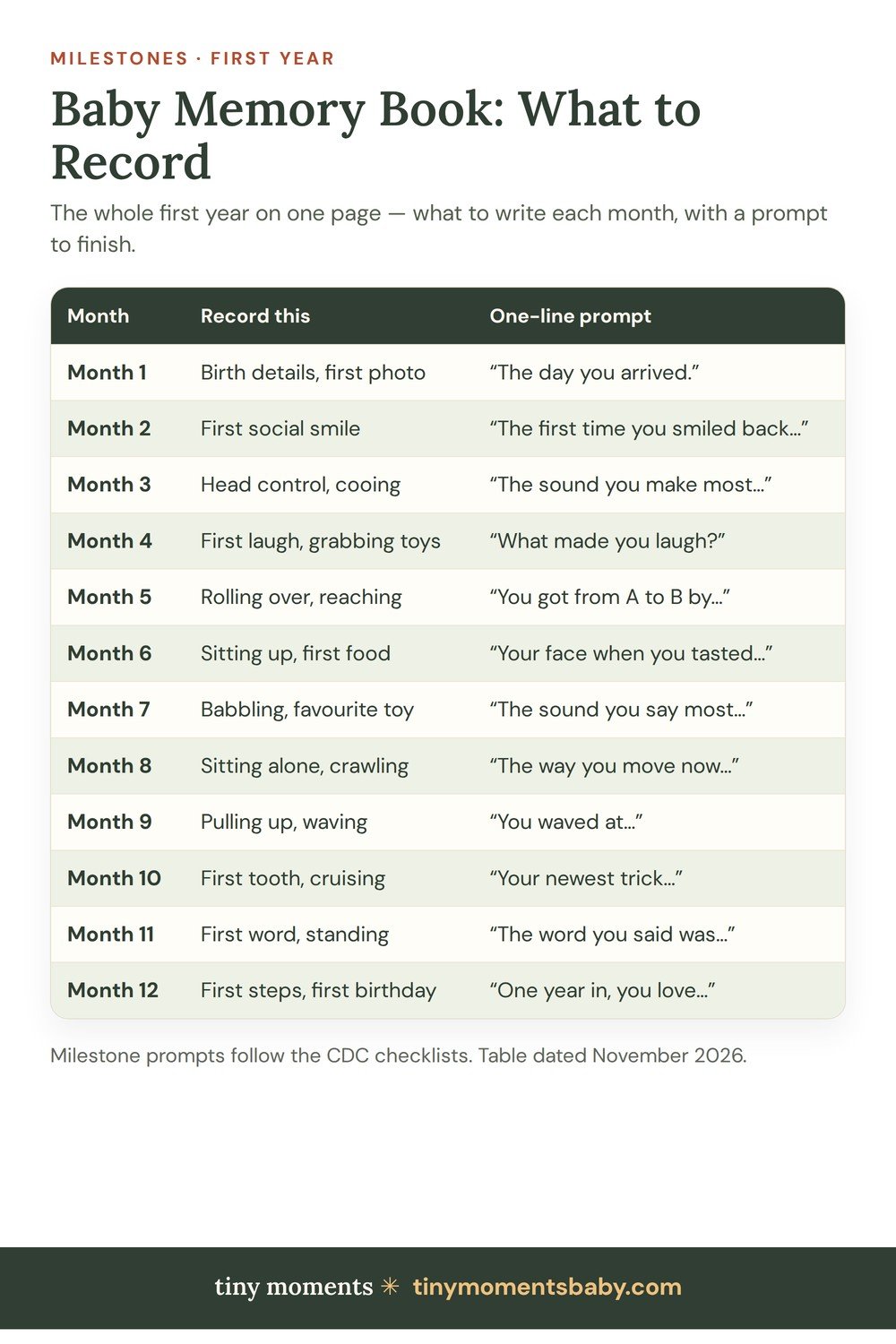
Tip: this table scrolls sideways on small screens.
Two habits make the table work. First, take the month's photo in the same spot every month — the same chair, the same blanket, the same window light. Twelve photos in one spot tell the story of the year better than a thousand scattered ones. Second, if you are starting late, backfill from your phone: photo timestamps date each memory for you, and one line per month is enough to catch up. A half-filled book is still a keepsake; a perfect blank one is not.
Start recording firsts — free
The free Tiny Moments starter pack gives you four printable keepsake pages to begin with: a first-year calendar, a milestone card and more, straight to your inbox.
Get the free starter pack →The 10-minute monthly routine that keeps the book alive
Most baby books fail the same way: a beautiful first month, three blank months, then guilt. The fix is a routine so small it survives tiredness. Here it is, in five steps, once a month:
- Pick one day and keep it. The easiest choice is your baby's monthly birthday — the same date each month. Set a repeating phone reminder now, while you are thinking of it.
- Keep a running note on your phone. Name it after the month and add a line when something happens — a date and five words is enough. “First proper laugh — at the dog drinking.” That line, written in the moment, is worth more in twenty years than a polished paragraph written from memory.
- Take the same-spot photo. Same chair, same blanket, similar time of day. Keep your baby awake and within arm's reach, on the floor.
- Fill the page in ten minutes. Copy the month's numbers from the check-up summary if there was one — length, weight and head size — then answer the month's prompt from the table in two or three sentences. Specific beats pretty.
- Record the sound, too. A 20-second voice memo of the sound they make most this month. Sounds change fast, and no photo captures a babble.
The standard to hold yourself to is this: one line and one photo is a complete entry. A date and five words beats a beautiful page you never wrote. And on a month when nothing new happened, write “nothing new” — it is a real entry, and it is honest. In the very first weeks, sleep changes just as fast as skills do; our newborn sleep schedule by week shows what that side of the first year typically looks like, so the sleep notes on your monthly page have something to lean on.
Print or digital: which book fits your life?
Before you buy a book or download an app, answer four questions honestly — they decide the format better than any product review:
- How much time will you really give it each month? Ten minutes, once a month, is enough for a printed book. If even that feels like a lot right now, start with phone notes and print later — the notes are the book, the paper is just where they land.
- Who will read it in twenty years? If the answer is your child, a printed book wins: it sits on a shelf, needs no password, and handwriting in it is part of the gift. If the answer is family far away, a digital copy matters too.
- What happens if the app closes? Apps shut down, subscriptions lapse, phones get lost. A printed page survives all three. Whatever you choose digitally, keep a copy you own — a PDF, a printed page, a backup folder.
- Do you want your handwriting in it? Some parents do, some do not. There is no wrong answer — but if the answer is yes, only paper gives it to you.
| Format | Cost | Effort | What lasts | Best for |
|---|---|---|---|---|
| Printed book | Print at home, a few dollars of paper | 10 minutes a month, by hand | A shelf keepsake, no battery needed | The child who will hold it in 20 years |
| Digital book | Often free, storage limits apply | Fast to capture, easy to forget | As long as the app and your account survive | Sharing with family far away |
| Hybrid (our pick) | Print only the pages that matter | Phone notes during the month, one print day | Best of both — paper plus a backup copy | Most families, most of the time |
Comparison current as of November 2026. Our honest recommendation is the hybrid row: capture on your phone all month, print one page a month, and keep a digital copy as the backup. It is the only format that survives both a lost phone and a forgotten month — and it is exactly how our own printable kit is designed to be used. More keepsake ideas live in our Milestones & Keepsakes section.
The firsts that don't belong to a month
A few big moments refuse to sit neatly in a monthly row. Give each of them its own dated line whenever it happens, in the month it happens:
- First tooth — the date is enough; the sleepless nights that came with it are the story.
- First bath without tears — and the first bath, for that matter.
- First haircut — keep a small lock of hair in an envelope if you can.
- First trip, first holiday, first time at the beach — where you went matters less than who was there.
- First time meeting grandparents or a sibling — the faces in the photo are the point.
- First longer stretch of sleep — a small mercy worth recording, for you as much as for them.
- First time they recognised someone across a room — underrated, and it disappears from memory fast.
And the everyday things no printed book has a page for: what the house sounded like at three in the morning, the song that worked when nothing else did, what you ate one-handed standing up. These are the entries your future self will cry over. Write the approximate date and the circumstance — “First proper laugh — at the dog drinking” is worth far more in twenty years than a date sitting alone on a line.
Keeping it honest: milestones are not a test
A memory book that doubles as a scorecard stops being a keepsake. Three facts keep it honest:
First, the range is the point. A milestone appears on the CDC checklist when about 75% or more of babies can do it by that age. That means up to a quarter of perfectly typical babies do it a little later. One late skill, on its own, is information — not a verdict. Babies also develop in their own order: some pour everything into movement and talk later, others chat early and cruise late, and some skip steps entirely — crawling does not even appear on the CDC checklist, because so many healthy babies go straight from sitting to pulling up.
Second, use the right age. If your baby was born early, use their corrected age — age counted from the due date, not the birth date — when you read any milestone list. Pediatric guidance uses corrected age for development until around the second birthday, because early babies have simply had less time.
Third, know the one signal that matters. If your baby loses a skill they once had, at any age, call your pediatrician promptly — that is the one milestone signal every source treats as urgent. The AAP also recommends developmental screening at 9, 18 and 30 months, which is exactly what those check-ups are for. Everything else in this guide is a prompt for a memory, not a deadline — record what actually happens in your family and leave the rest blank without guilt.
Questions parents ask us
When should I start a baby memory book?
Any time — including now. If your baby is already 6 months old, backfill the early months from your phone photos: the timestamps date them for you, and one line per month is enough. Starting late beats never starting, and a half-filled book is still a keepsake.
What do I write on each monthly page?
Three things: the date, one photo, and one sentence about what happened — what it was, where you were, and who was there. Use the month-by-month table's prompt for that month if the blank page feels intimidating. One line and one photo is a complete entry.
Should I make a printed book or a digital one?
Most families end up happiest with a hybrid: capture moments on your phone during the month, then print one page a month. A printed book is the keepsake your child will hold in twenty years; a digital copy is the backup that survives a move, a spill or an app shutting down.
My baby skipped a milestone on the chart — should I worry?
Almost always, no. Milestones describe what about 75% or more of babies can do by a checkpoint age, so up to a quarter of typical babies do the same skill a little later. One late skill is variation, not a verdict. The one signal to act on promptly is a skill your baby once had and then lost — call your pediatrician about that at any age.
A home for every first
The Tiny Moments Complete Kit is the printable baby book this guide belongs in: memory book pages for every month, milestone cards for every checkpoint, a first-year calendar, a baby stats poster and handprint keepsakes — print at home, fill in as the firsts happen, keep forever.
$9.99 one-time · print at home, keep forever
See the Complete Kit →Keep reading
 MilestonesBaby Milestones Chart 0–12 Months (Free Printable)The CDC checkpoints for 2, 4, 6, 9 and 12 months in one calm chart — what most babies do, and how to record every first.
 Baby NamesBaby Names That Mean Blessing, Gift or MiracleThirty-six names that carry the story — literal miracle names, gift-of-God classics and blessing names — with how to say each one and honest US popularity.
 Baby SleepWhy Is My Baby Waking Up Early? Fixing 5–6 AM WakingsBefore 6 a.m. counts as early. Find your cause in the morning pattern — light, bedtime, naps or habit — and the single fix to try first.
 Baby NamesItalian Baby Names & Meanings: 40 Picks Parents LoveForty Italian names parents love — with meanings, pronunciations and honest US popularity, plus a calm way to choose together.
 Baby NamesTop Baby Names & Meanings: 30 Loved Picks for Girls, Boys & AnyoneThirty loved names — girls, boys and unisex — with the meanings they are most often given, plus a calm way to choose together.
Swipe sideways for more →
Sources & further reading: CDC — Developmental Milestones & Learn the Signs · HealthyChildren.org (American Academy of Pediatrics) — parent guidance on development
Educational information only, not medical advice.