
Home · Blog · Baby Names
Spanish Baby Names That Work in English Too: 40 Picks
Spanish names are the warmest shortcut in baby naming: they sound beautiful in two languages at once. Mateo is mah-TAY-oh in Spanish and MAT-ay-oh in English — and both are right. Camila is the No. 11 girls' name in America. Mía is No. 5. This is our shortlist of forty Spanish baby names that work in English too: fifteen for girls, fifteen for boys, and ten that work for anyone. Every one comes with the meaning it is most often given, its root, how to say it, and honest US popularity from the Social Security Administration's 2024 data — and every one has been checked against the question the other lists never ask: can an English speaker say it, and spell it, the first time they hear it?
How to say Spanish names: the 6 rules
Spanish is one of the kindest languages to pronounce — once you know the six rules, every name in this guide becomes sayable, and most of them become sayable in English too. 1. Vowels are pure. a is "ah" (as in father), e is "eh" (as in bet), i is "ee" (as in machine), o is "oh" (short, as in go), u is "oo" (as in food) — and they never change, whatever letters sit next to them. 2. j says "h". Javier is hah-vee-AIR, not JAV-ee-er; Jesús is heh-SOOS. 3. h is silent. It says nothing at all, ever. 4. ll and y say "y". 5. ñ says "ny", as in canyon. 6. The written accent marks the stress. Words ending in a vowel, n or s stress the second-to-last syllable; anything else stresses the last — and any written accent overrides both, so it is Jo-SÉ, not JO-se. The one letter that breaks the pattern is x in Ximena — hee-MEH-nah, where the x says "h" (in Xavier it can be "h", "sh" or "ks" by family). Learn these six rules once and the whole list opens up.
One honest warning before the tables: the hardest names to live with are not the hardest to say — they are the hardest to spell for everyone else. The test this whole guide is built on is simple: say the name once in English, ask someone who has never seen it to spell it, and check the two hard sounds — j as "h", and x as "h" in Ximena. Names that pass all three are the "works in English" lane, and most of the forty do. That is also why every name below carries a plain-English "say it" — and why the decision section at the end gives you a one-minute test to run on your finalists before the birth announcement. If you love the sound of a language with its own spelling rules, our Irish baby names list works the same way, with seven rules of its own.
A few honest disagreements, stated up front: Camila's "young ceremonial attendant" is the popular gloss — scholars say the Camillus root is probably Etruscan, and its meaning is uncertain. Ximena's meaning is genuinely unsettled: "hearing, listening" if it comes from Simon, "son" if it comes from the Basque word seme. Diego is "supplanter" by tradition, but medieval records Latinised it as Didacus, and it may in fact come from the Greek didache, "teaching". Bruno is "brown" in the popular reading, "armour, protection" in the scholarly one. Mía means "mine" — the "drop of the sea" gloss you will see online belongs to Maria, not to Mia. And Camila is not Camilla: Camila is the Spanish spelling, Camilla the Latin one — our Latin baby names list has Camilla, and the two spellings are different names with different histories. The same honesty runs through the popularity figures: seven names here sit outside the US top 1,000, and they are listed as outside, not dressed up as rare gems with a rank they do not have.
Spanish girl names
| Name | Often associated with | Say it | Roots |
|---|---|---|---|
| Camila | Young ceremonial attendant (popular gloss; earliest meaning uncertain) | kah-MEE-lah | Latin Camillus via Spanish |
| Carmen | Song (also "garden" via Hebrew karmel) | KAR-men | Spanish, from Our Lady of Mount Carmel |
| Isabel | My God is an oath | ee-sah-BEL | Medieval Occitan form of Elizabeth (Hebrew Elisheva) |
| Alba | Dawn; white | AHL-bah | Latin albus / Spanish word-name (multiple origins) |
| Marisol | Sea and sun; Mary of Solitude | mah-ree-SOL | Spanish, short form of María Soledad |
| Mía | Mine (diminutive of María) | MEE-ah | Spanish/Italian word |
| Esmeralda | Emerald | es-meh-RAHL-dah | Spanish word, from Greek smaragdos |
| Mariana | Of Marius (popularly read as María + Ana) | mah-ree-AH-nah | Roman Marianus |
| Beatriz | She who brings happiness; blessed (originally "voyager") | bay-ah-TREEZ | Spanish form of Beatrix (Latin Viatrix) |
| Renata | Reborn | reh-NAH-tah | Latin Renatus |
| Ximena | Of uncertain meaning; possibly "hearing, listening" or "son" | hee-MEH-nah | Medieval Spanish/Basque Ximeno |
| Adriana | From Hadria | ah-dree-AH-nah | Latin Hadrianus |
| Daniela | God is my judge | dah-nee-EL-ah | Hebrew Daniyyel |
| Gabriela | God is my strength | gah-bree-EL-ah | Hebrew Gavri'el |
| Alicia | Noble | ah-LEE-see-ah | Latinized Alice, Germanic Adalheidis |
Tip: this table scrolls sideways on small screens.
The girl names split into two groups worth noticing. The first is the familiar end — Mía (#5) and Camila (#11) are two of the most popular girls' names in America, and Isabel (#167), Ximena (#174) and Mariana (#242) are all inside the top 250; every one of them passes the English-friendly test on the first try. The second is the beautiful-but-brave end: Alba and Beatriz sit outside the US top 1,000 entirely — Alba is a word-name, "dawn", with Latin, Germanic and Spanish roots at once, and Beatriz is "she who brings happiness", originally "voyager". Two honest notes from the research: Carmen is the No. 8 girls' name in Spain in 2025 but only #417 in the US in 2024 — a name Spain already loves and America is still meeting — and Ximena, at #174, is the name whose meaning nobody can settle, so we print the uncertainty instead of picking a favourite gloss. If you want the same honesty applied to the most-loved names of all, our top baby names list ranks every name the same way.
Spanish boy names
| Name | Often associated with | Say it | Roots |
|---|---|---|---|
| Mateo | Gift of God | mah-TAY-oh | Spanish form of Matthew (Hebrew Mattiyahu) |
| Sebastián | Venerable; from Sebaste | seh-bahs-tee-AHN | Latin Sebastianus, Greek sebastos |
| Diego | Supplanter (traditionally); possibly from Greek didache, "teaching" | dee-AY-goh | Spanish, disputed derivation |
| Miguel | Who is like God? | mee-GEL | Spanish form of Michael (Hebrew Mikha'el) |
| Javier | New house | hah-vee-AIR | Basque Etxeberri |
| Carlos | Free man | KAR-los | Spanish form of Charles (Germanic Karl) |
| Andrés | Manly; brave | ahn-DRES | Spanish form of Andrew (Greek Andreas) |
| Rafael | God has healed | rah-fah-EL | Spanish form of Raphael (Hebrew Rafa'el) |
| Nicolás | Victory of the people | nee-koh-LAHS | Spanish form of Nicholas (Greek Nikolaos) |
| Santiago | Saint James | sahn-tee-AH-goh | Spanish santo + Yago |
| Bruno | Brown (also possibly "armour, protection") | BROO-noh | Germanic brun |
| Tomás | Twin | toh-MAHS | Spanish form of Thomas (Aramaic Te'oma) |
| Alejandro | Defending men | ah-leh-HAHN-droh | Spanish form of Alexander (Greek Alexandros) |
| Daniel | God is my judge | DAN-yul (Spanish dah-nee-EL) | Hebrew Daniyyel |
| Emiliano | Rival (also "eager") | eh-mee-lee-AH-noh | Roman Aemilianus, Latin aemulus |
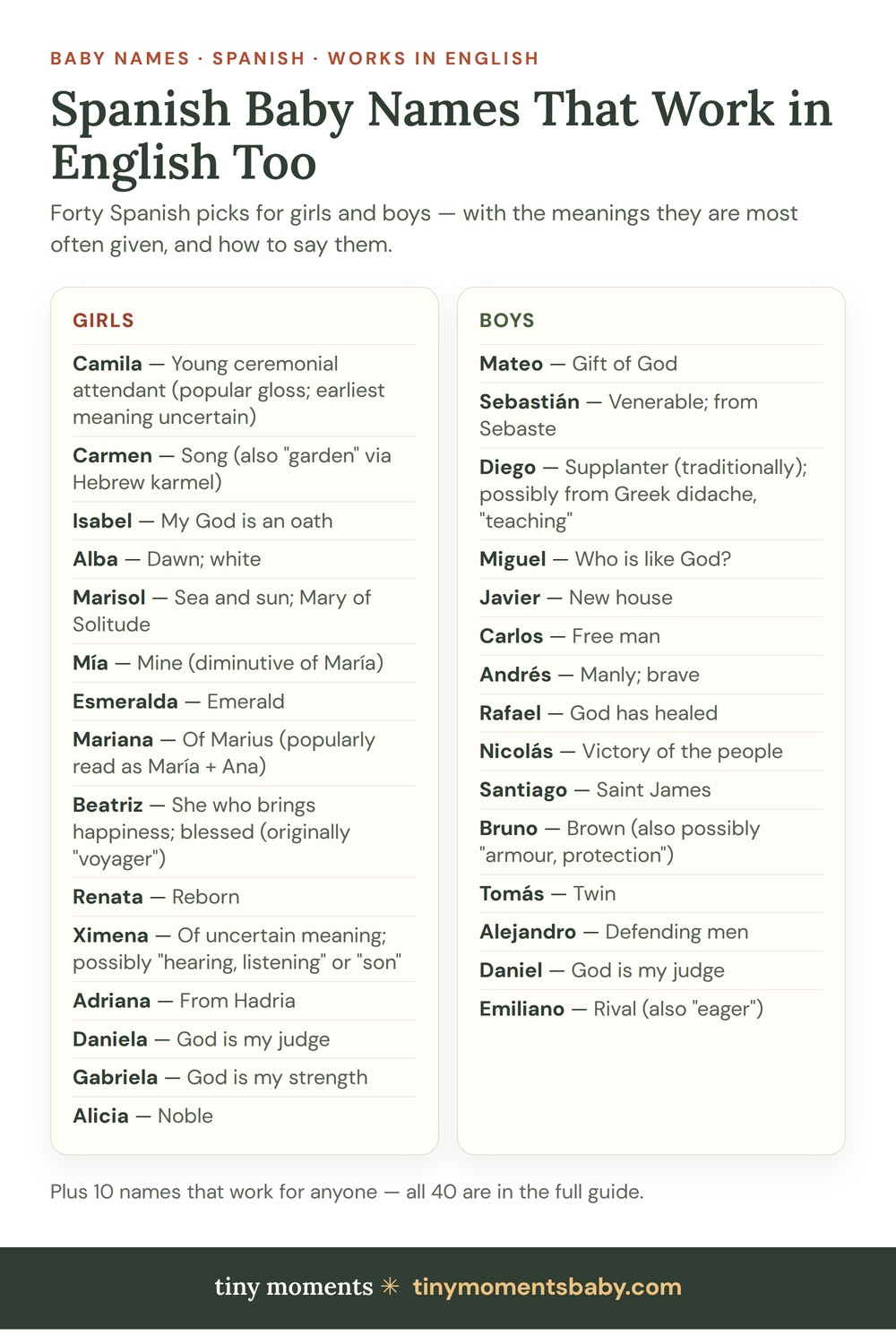
Take all 40 names with you
The full list as a calm printable — every name with its meaning, roots and how to say it, plus the two-list trade worksheet from this guide. Tell us where to send it.
Free · Your PDF arrives by email in a minute or two · Unsubscribe any time
Tip: this table scrolls sideways on small screens.
The boy names are the strongest proof of the whole idea: all fifteen sit inside the US top 1,000 — the only table in this guide where that is true. Mateo (#7) is the No. 1 boys' name in Spain in 2025 and No. 7 in the US in 2024; Sebastián (#14), Daniel (#16) and Santiago (#29) are all inside the top 30. The quiet end is Bruno (#704) and Tomás (#735) — familiar names, rarely heard on a playground. Two honest notes: Javier's "new house" comes from the Basque Etxeberri, not from Spanish at all, and Diego's "supplanter" is the traditional reading — the medieval Latin form Didacus points to the Greek didache, "teaching", so we print both. If you want the same honesty applied to names chosen for what they mean rather than where they come from, our strong baby names list ranks every name the same way.
Spanish names that work for any baby
| Name | Often associated with | Say it | Roots |
|---|---|---|---|
| Cruz | Cross | KROOZ (Spanish KROOS) | Spanish word, Latin crux |
| Río | River | REE-oh | Spanish/Portuguese word, Latin rivus |
| Mar | Sea | MAR | Spanish/Catalan word, Latin mare |
| Azul | Blue | ah-ZOOL | Spanish word, via Arabic/Persian |
| Paz | Peace | PAHZ | Spanish word, Latin pax |
| Luz | Light | LOOS | Spanish word, Latin lux |
| Cielo | Sky, heaven | see-EL-oh | Spanish word, Latin caelum |
| Reyes | Kings | RAY-ez | Spanish word, Marian title La Virgen de los Reyes |
| Ariel | Lion of God | AIR-ee-el | Biblical Hebrew (used in Spanish) |
| Rosario | Rosary | roh-SAH-ree-oh | Spanish/Italian, Marian title Nuestra Señora del Rosario |
Tip: this table scrolls sideways on small screens.
An honest note before you fall for this list: only one of these ten is genuinely balanced in American use — Ariel (#509 boys, #300 girls). The rest lean one way: Cruz (#303 boys) and Río (#517 boys) lean boy, Luz (#747 girls) and Cielo (#807 girls) lean girl, and Mar, Azul, Paz, Reyes and Rosario sit outside the top 1,000 on both sides. Most of them are Spanish word-names — sea, blue, peace, light, sky, kings, cross, river, rosary — which is why they travel so easily between boys and girls: a word does not carry a gender the way a saint's name does. Parents online ask whether a word like "Moon" is a real name at all — in Spanish it is ordinary: Luna is a common Spanish girls' name, and Mar, Luz and Cielo have been given names for generations. Two honest notes: Paz is "peace" in Spanish — the Hebrew word paz means "gold", a separate origin, not the Spanish meaning — and Mar's "sea" is the only published meaning; a "March" reading floating around online has no corroboration, so we do not print it. If you want the same honesty applied to names that are rare for a different reason, our rare baby names list ranks every name the same way.
Keep your shortlist somewhere beautiful
Our free Spanish baby names printable has all forty names with meanings, roots and pronunciations, plus the two-list trade worksheet for narrowing your finalists together — print it, pin it to the nursery wall, and let the names compete in daylight.
Get the free printable →How popular are Spanish names in the US, really?
A name's popularity is not a quality judgement — it is a practical one. A top-10 name will be recognised instantly and shared with classmates; a name outside the top 1,000 will feel familiar without being everywhere. This is where the forty names on this list fall, using the US Social Security Administration's 2024 baby-name data, checked November 2026. Table dated November 2026.
| US popularity (SSA 2024) | Names from this list | What it tells you |
|---|---|---|
| Inside the US top 100 | Mía (#5 girls), Mateo (#7 boys), Camila (#11 girls), Sebastián (#14 boys), Daniel (#16 boys), Santiago (#29 boys) | The familiar end of the list — Spanish names America already loves. Mía is the highest-ranked girl name in this guide, and Mateo is the highest-ranked boy name — and the No. 1 boys' name in Spain in 2025. |
| Between #100 and #300 | Emiliano (#113 boys), Carlos (#135 boys), Diego (#145 boys), Isabel (#167 girls), Ximena (#174 girls), Nicolás (#184 boys), Alejandro (#186 boys), Miguel (#189 boys), Andrés (#197 boys), Rafael (#222 boys), Mariana (#242 girls), Javier (#247 boys), Daniela (#280 girls), Gabriela (#298 girls) | Well known, rarely crowded — the sweet spot of this list. Fourteen of the forty live here, the biggest band in the guide. |
| Between #300 and #500 | Ariel (#300 girls), Cruz (#303 boys), Adriana (#322 girls), Esmeralda (#350 girls), Carmen (#417 girls), Alicia (#438 girls) | On the map, but uncommon — these are the names other parents are already discovering. Ariel appears twice: it also ranks #509 for boys, in the band below. |
| Between #500 and #1,000 | Río (#517 boys), Renata (#520 girls), Ariel (#509 boys), Bruno (#704 boys), Tomás (#735 boys), Marisol (#737 girls), Luz (#747 girls), Cielo (#807 girls) | The quiet end of the ranked list — familiar names, rarely heard on a playground. Ariel appears twice: it ranks #300 for girls, in the band above. |
| Outside the US top 1,000 | Alba, Beatriz, Mar, Azul, Paz, Reyes, Rosario | The rare end — beautiful meanings, rarely heard. Seven of the forty sit here, and this guide says so plainly: a Spanish name does not need a rank to be a good name. Note the contrast with Spain itself: Carmen is the No. 8 girls' name in Spain in 2025, yet #417 in the US — a name Spain already loves and America is only just meeting. |
Tip: this table scrolls sideways on small screens.
One pattern worth noticing: the names at the very top of this list are the ones that sound English already — Mía, Mateo, Camila, Daniel — while the names at the quiet end are mostly the word-names, still waiting for America to learn the six rules. That is the whole opportunity of this list: a name with a beautiful meaning and a story nobody else on the playground is using. Popularity figures above are from the SSA's 2024 US baby-name data, as checked in November 2026.
Can we use a Spanish name if we're not Hispanic? Choosing with intention
Forty names become the name with a method, not an argument. First, pick your lane — then run your top five through the three checks below. Each check takes about a second.
- Pick the lane first. Classic: Mateo, Isabel, Carlos, Rafael, Mariana — names your grandparents would recognise. Word-name: Marisol, Luz, Cielo, Río, Mar — sea, light, sky, river, a name that is a picture. Crossover: Mía, Daniel, Camila, Diego, Alicia — names English speakers already say right, in both languages. A name can sit in two lanes — Camila is classic and crossover, Marisol is word-name and classic — so if a name appears in two lanes, that is a point in its favour, not a confusion.
- Run the English-friendly test. Say the name once in English, ask someone who has never seen it to spell it, and check the two hard sounds: j as "h" (Javier) and x as "h" (Ximena). If a reasonable guess lands near the truth, it passes. Most names here pass easily — Mía, Mateo, Camila, Daniel and Isabel have nowhere to hide a surprise letter — but Ximena and Javier are worth one test run. If the spelling test fails and you still love the name, that is what the unaccented spelling is for: Sebastian instead of Sebastián, Andres instead of Andrés — the sound survives, the spelling burden goes.
- Decide the accents — and commit. The accent changes the stress, so dropping it is a choice, not a shortcut: Sebastián without the accent invites "se-BAS-tee-an", and José without it becomes JOSE. Whether a US state allows accents on a birth certificate varies, and English speakers will drop them in everyday use — so pick one spelling and use it everywhere, including the birth announcement. What causes trouble is mixing them, or switching halfway: a name spelled two ways on two documents is a burden no spelling can fix.
- Answer the "can we use it?" question honestly. Yes — no Spanish ancestry is required, just intention behind why the name matters to you: honouring heritage, a real connection, or love of the language. What matters is the name's meaning and pronunciation, not your ancestry. One thing to know before you choose: sacred names carry different weight across cultures. Jesús is an ordinary boy's name in Mexico — naming a child Jesús is an expression of religious identity, not a claim that the child is God — while in the US it sounds strange to most ears. That does not make it wrong; it makes it a name to choose with your eyes open, knowing the weight it carries on both sides.
- Check the nickname. A Spanish name has a short form waiting — Mateo becomes Teo or Matty, Camila becomes Cami or Mila, Sebastián becomes Seb, Rafael becomes Rafa, Marisol becomes Mari. Decide whether you like the short version too — if you hate it, pick a name whose short form you love, because you will hear it every day.
- Check the popularity comfort. Top-20 familiar (Mía, Mateo, Camila) or outside-the-top-1,000 rare (Alba, Beatriz, Mar)? Both are fine — but know which one you picked, so the first time you meet another Camila at the playground it is a pleasant surprise, not a shock.
Then the 3-step shortlist — say it once, spell it once, shout it once:
- Say it once. Say the full name with your surname three times — whispered at 2 a.m., called across a playground, read out at a graduation. If you stumble twice, expect to teach it often, and decide whether that bothers you before the birth announcement.
- Spell it once. Say it to someone who has never seen it and ask them to spell it. If a reasonable guess lands near the truth, it passes. Most names here pass easily — Mía, Mateo, Camila and Daniel have nowhere to hide a surprise letter — but Ximena and Javier are worth one test run.
- Shout it once. Stand at the back door and call it the way you will a thousand times. A name that sounds beautiful at a whisper and still sounds like itself at full volume is the one. This is where the soft names earn their keep: Mía, Luz, Mateo and Río all carry across a yard without stretching.
Still tied between two? Use the two-list trade: each partner writes five names privately, swaps lists, and may veto exactly two from the other list. What survives both vetoes is your real shortlist — usually three names, and almost always the right three. Then live with each finalist for a day, referring to the baby by one name all day and the other the next. Most couples know by lunchtime on day two. One last reassurance: a Spanish name is an ordinary name — Mateo is just a gift of God, Luz is just light, and Marisol is just sea and sun. You are not borrowing something difficult; you are picking a name that happens to be spelled the Spanish way. The free printable with this guide includes the two-list trade as a worksheet, so you can do it on paper instead of in an argument.
Questions parents ask us
What Spanish names work in English too?
The ones that pass three checks: say it once in English and it sounds right, spell it once from hearing and a reasonable guess lands near the truth, and neither of the two hard sounds trips you up — j as "h" (Javier) and x as "h" (Ximena). Mía, Mateo, Camila, Daniel, Isabel, Diego and Alicia pass all three without trying; Ximena and Javier need one practice run. The full test, with all forty names, is in the decision section above.
Do Spanish names need accent marks in the US?
The accent marks the stressed syllable, so it changes the sound: Sebastián, Andrés and José are stressed on the marked vowel, and dropping the mark invites the wrong stress. Whether a US state allows accents on a birth certificate varies, and English speakers will drop them in everyday use — so the practical answer is to pick one spelling and use it everywhere. If you keep the accents, keep them on every document; if you drop them, drop them on every document. What causes trouble is mixing them, or switching halfway.
Can I use a Spanish baby name if we're not Hispanic?
Yes — no Spanish ancestry is required, just intention behind why the name matters to you: honouring heritage, a real connection, or love of the language. What matters is the name's meaning and pronunciation, not your ancestry. One thing to know before you choose: sacred names carry different weight across cultures. Jesús is an ordinary boy's name in Mexico — an expression of religious identity — while in the US it sounds strange to most ears. That does not make it wrong; it makes it a name to choose with your eyes open, knowing the weight it carries on both sides.
How do I shortlist 40 Spanish names to 3 finalists?
First pick your lane — classic (Mateo, Isabel, Carlos), word-name (Marisol, Luz, Cielo) or crossover (Mía, Daniel, Camila) — then use the 3-step shortlist: say it once, spell it once, shout it once — each check takes about a second and each one cuts names that look good on paper but do not work out loud. Then use the two-list trade: each partner writes five names privately, swaps lists, and may veto exactly two from the other list. What survives both vetoes is your real shortlist — usually three names, and almost always the right three. Then live with each finalist for a day, referring to the baby by one name all day and the other the next. Most couples know by lunchtime on day two. The free printable with this guide includes the two-list trade as a worksheet, so you can do it on paper instead of in an argument.
The name deserves a first page
Whichever Spanish name wins, its first outing should be beautiful. The Tiny Moments Complete Kit opens with a name-and-arrival page in a full printable baby book — milestone cards, a first-year calendar, a stats poster and handprint keepsakes included.
$9.99 one-time · print at home, keep forever
See the Complete Kit →Written by Sahinul Islam Laskar, founder of Tiny Moments
Sahinul runs Tiny Moments, a small independent studio making calm, practical printables and guides for new parents. He is not a medical professional: everything here is educational information drawn from published guidance (AAP, CDC) and official data (SSA) — never a substitute for your paediatrician's advice.
Keep reading
 Baby NamesIrish Baby Names & Meanings: 40 Picks, Said RightForty Irish names — classic, mythic and nature picks — with meanings, pronunciations and honest US popularity.
 Baby NamesBaby Names That Mean Strong: 40 Powerful PicksForty names that mean strong — warrior, protector or ruler — with meanings, pronunciations and honest US popularity.
 Baby NamesLatin Baby Names & Meanings: Timeless RootsForty Latin names — timeless roots, honest US popularity — with meanings, pronunciations and a lane-choosing guide.
 Baby NamesShort Baby Names (3–4 Letters) That Feel CompleteForty short names — 3–4 letters, complete as they stand — with meanings, pronunciations and the nickname-trap test.
 Baby NamesSouthern Baby Names: Sweet Classics & Cowgirl PicksForty Southern names — sweet classics and cowgirl picks — with meanings, pronunciations and honest US popularity, plus a lane-choosing guide.
Swipe sideways for more →
Sources: U.S. Social Security Administration — Baby Names data (2024) · Behind the Name — Popular Names in the United States 2024 · Nameberry — Spanish Baby Names · Inklingo — Spanish Baby Names: 200+ Beautiful Names with Meanings · Mexican Name Finder — Spanish Name Pronunciation Guide · Onzenna — Spanish Baby Names: Beautiful, Meaningful Options. Popularity figures checked November 2026. Meanings reflect the associations most commonly published for each name and vary by source and culture.
Educational information only, not medical advice.