
Home · Blog · Milestones & keepsakes
Baby Milestone Cards: How to Use Them (Photo Ideas by Month)
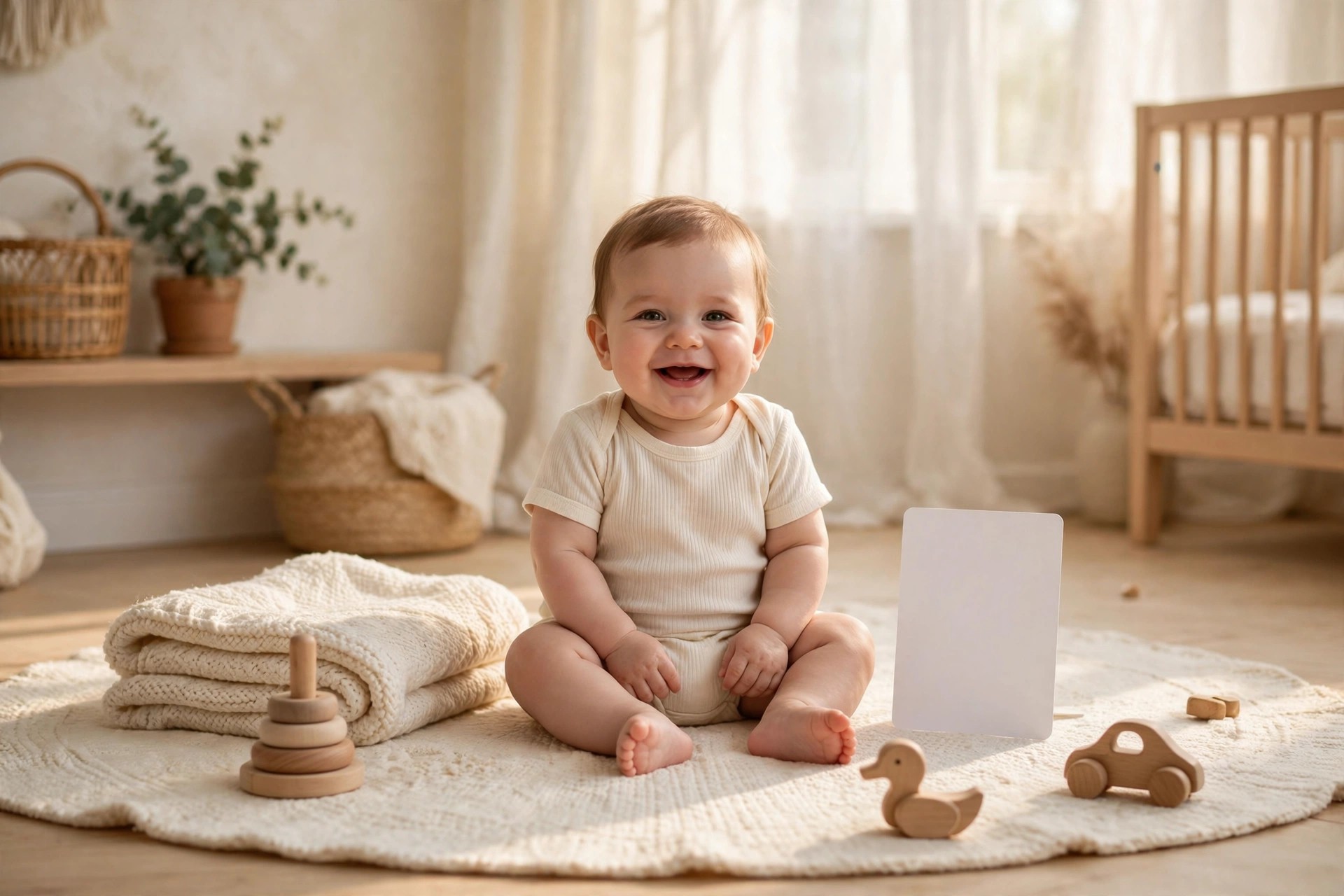
Milestone cards are small printed cards — one for each month and one for each first — that you prop next to your baby for a monthly photo. The method takes about five minutes a month: pick the card, set up in the same spot by a window, place the card where the camera can read it, take several photos, and write the date on the back. Below are the five steps, a photo idea for every month of the first year, and an honest way to choose between cards, a blanket, an app or a letter board.
What are baby milestone cards?
A milestone card is a small printed card with one thing on it: an age (“1 month”, “6 months”) or a first (“first smile”, “first tooth”). You place it beside your baby and take a photo, so the picture itself records when it was taken and what was happening. Most sets have two kinds of card:
- Monthly age cards — one for each month of the first year, newborn through 12 months. These are the backbone: the same photo, once a month, shows the year passing.
- Firsts cards — one for each big moment: first smile, first laugh, first roll, first sit, first tooth, first taste of food, first crawl, first steps, first word. You pull one out only when that first actually happens.
Printed paper cards are the most common — most are square, about 4×4 to 5×5 inches, and a ready-made set typically holds 30–60 cards. Wooden discs last longer but cost more; printable sets are the budget route; a few parents use an app that stamps the age onto the photo instead. All four work — what differs is cost, effort and what you are left holding in twenty years, which the decision section below covers.
One thing the cards are not: a test. The ages on them are months, not milestones — a card that says “6 months” records a date, not a skill your baby must have by then. The CDC's checklists describe what most babies (about 75% or more) can do by the checkpoint ages of 2, 4, 6, 9 and 12 months; our baby milestones chart for 0–12 months lays those checkpoints out in one place.
How to use baby milestone cards: the 5-step method
The method is the same every month, which is the whole point — a repeatable five minutes beats a perfect photoshoot you never repeat. Do it on your baby's monthly birthday, the same date each month, and set a repeating phone reminder now while you are thinking of it.
- Pick the card for this month. The age card for the month you are in. If a first happened since the last photo — a first tooth, a first proper laugh — pull that card out too and take one photo with each.
- Set up in the same spot. The same chair, the same blanket, the same window. Put your baby on the floor on a blanket or play mat, near a window with indirect natural light. Keep your baby within arm's reach, always.
- Place the card where the camera can read it. Beside your baby, not behind them — flat on the blanket or propped against a cushion, facing the camera, in the same corner of the frame every month.
- Take several photos. Five to ten, not one: a close one with the card clearly readable, a wider one showing the whole setup, and a couple of spares while your baby is smiling. The best photo is rarely the first one.
- Write the date on the back. The date, and one line if there is one — what happened, where you were, who was there. Then put the card with the month's photos, so the card and the picture stay together.
That is the whole method. If you remember nothing else, remember this: same spot, same light, card readable, date on the back.
Photo ideas by month: the 1–12 table
Each month has one photo idea and one line to write. The ideas follow the year as it usually unfolds, and the milestone prompts lean on the CDC checklists — but treat every row as a suggestion, not a deadline: if your baby does something a month early or a month late, photograph it in the month it actually happened. The table is dated November 2026.
| Month | Photo idea | Write this |
|---|---|---|
| Month 1 | Wrapped and sleeping, card beside the blanket | “The day you arrived.” |
| Month 2 | Face to face — watch for the first smile back | “The first time you smiled back…” |
| Month 3 | Tummy time, card at the edge of the frame | “You held your head up for…” |
| Month 4 | Catch the first proper laugh, card propped | “What made you laugh?” |
| Month 5 | Reaching for a toy beside the card | “You got from A to B by…” |
| Month 6 | Sitting up — first taste of food | “Your face when you tasted…” |
| Month 7 | Babbling with a favourite toy | “The sound you say most…” |
| Month 8 | Sitting alone, card on a cushion | “The way you move now…” |
| Month 9 | Pulling up and waving at the sofa | “You waved at…” |
| Month 10 | Cruising along the furniture | “Your newest trick…” |
| Month 11 | Standing and chatting, card in frame | “The word you said was…” |
| Month 12 | First steps and first birthday | “One year in, you love…” |
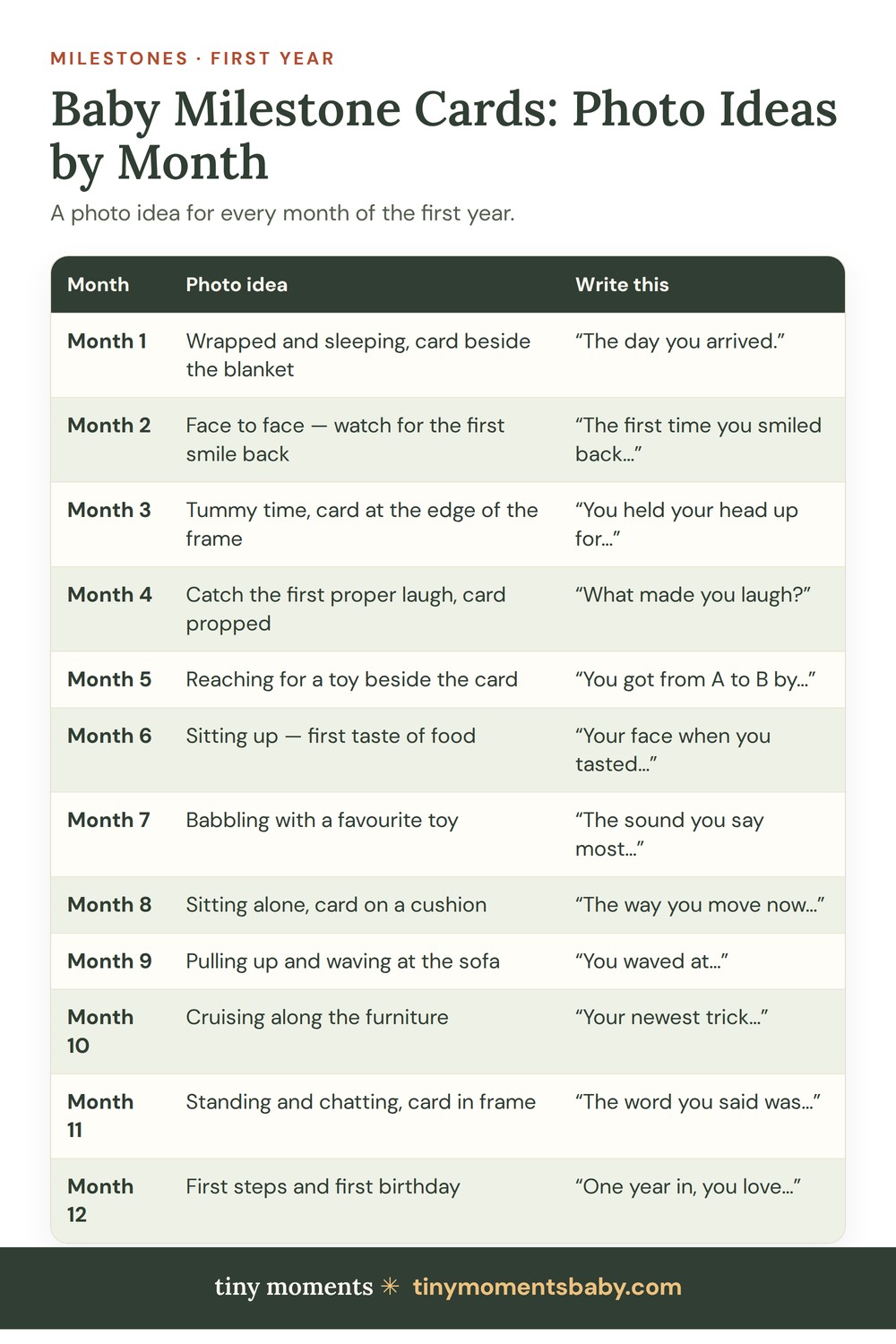
Tip: this table scrolls sideways on small screens.
Two habits make the table work. First, keep the setup boring: same spot, same blanket, similar time of day — twelve photos in one spot tell the year better than twelve different setups. Second, use the “firsts” cards when the moment happens, not when the month says so. If a month passes with nothing new, write “nothing new” on the back of that month's card: it is a real entry, and it is honest. Our baby memory book guide uses the same rhythm — one line and one photo is a complete entry there, too.
Start recording firsts — free
The free Tiny Moments starter pack gives you four printable keepsake pages to begin with: a first-year calendar, a milestone card and more, straight to your inbox.
Get the free starter pack →What to write on a baby milestone card
Keep the front clean — the age or the first is already printed on it. The writing goes on the back, and it only needs three things: the date (always — dates are the first thing to go); one sentence about what happened (what it was, where you were, who was there — “First proper laugh — at the dog drinking” beats a bare date); and the detail only you would know (which tooth, which word, what they were wearing).
If handwriting in the moment feels like too much, keep a running note on your phone named after the month and copy it onto the card later. The note is the memory; the card is just where it lands. With a printable set, print two copies of the cards you care about most — one for the photo, one to keep clean in the book.
Cards, blanket, app or letter board: which fits your family?
Every option photographs the same baby. What differs is what you do each month, what it costs, and what you are left with. Four questions decide it: how much time will you really give it each month? (five minutes with a card is the lightest option); do you want something to hold in twenty years? (only a physical card or print gives you that); who will see the photos? (family far away argues for an app or shared album); and do you like styling, or do you want the simplest thing? (a letter board is for parents who enjoy arranging the shot).
| Option | Cost | Effort each month | What lasts | Best for |
|---|---|---|---|---|
| Printed cards | A few dollars to about $20 a set | 5 minutes — pick the card, snap, write the date | A physical keepsake you can hold | Most families, most of the time |
| Milestone blanket | One purchase, similar price | 5 minutes, while baby stays on the blanket | The blanket itself, if you keep it | The early months, before baby starts rolling and crawling off it |
| App | Often free, storage limits apply | Fast to capture, easy to forget | As long as the app and your account survive | Sharing with family far away |
| Letter board | One purchase, reusable | Fiddly — letters to set out every month | A photo prop, not a keepsake | Parents who love styling the shot |
Comparison current as of November 2026. Our honest recommendation is the first row: printed cards win for most families — the lightest thing to do every month, and the only option that leaves you holding something in twenty years. A blanket is a lovely extra for the first few months, and an app is a good companion for sharing, but neither replaces the card. If you already own a blanket, use it while it works and switch to cards when your baby starts rolling off it. More keepsake ideas live in our Milestones & Keepsakes section.
Keeping monthly photos consistent
Consistency is what makes twelve separate photos feel like one story, and it comes from repeating five small choices: same spot (the same chair, the same blanket); same light (indirect natural light from a window, at a similar time of day — direct sun makes hard shadows and squinting; if the room is dim, move closer to the window rather than turning the flash on); same distance (stand in the same place and frame your baby the same way, the card in the same corner of the frame every month — the baby grows, the frame should not); same card placement (beside your baby, facing the camera, readable without zooming in — check the first photo on your screen before you put the card away); and same date (your baby's monthly birthday).
As your baby grows, adapt the pose, not the setup: a newborn lies on their back, a six-month-old sits, an eleven-month-old stands holding the furniture. The spot, the blanket and the light stay the same — only the baby changes.
When things don't go to plan
Almost every family hits one of these. None of them ruins the set.
You missed a month. Do not try to recreate it — a staged re-do never looks right. Take this month's photo on time, and backfill the missed month from your phone: photo timestamps date each memory for you. A missed month is not a failed book.
Your baby grabs or chews the card. Completely normal — at this age everything goes in the mouth. Prop the card just out of reach, lean it against a cushion, or hold it at the edge of the frame yourself. Treat cards as photo props, not toys, and put them away when the photo is done.
Your baby won't stay still, or cries through the whole thing. Try after a feed and a nap, when your baby is most settled, and keep it to five minutes. A familiar toy or a sound just above the camera catches their eye for the one second you need. If today is a no, tomorrow is fine.
Your baby skipped a milestone shown on the cards. Months are not milestones. The CDC checklists describe what about 75% or more of babies can do by a checkpoint age, so up to a quarter of typical babies do the same skill a little later — and babies develop in their own order. One late skill, on its own, is information, not a verdict. The one signal to act on promptly is a skill your baby once had and then lost — call your pediatrician about that at any age. The AAP also recommends developmental screening at 9, 18 and 30 months, which is exactly what those check-ups are for.
Photo safety: the rules that matter
Milestone photos should be the safest photos you take all month, because the whole setup is under your control. Three rules cover it: the crib stays empty — the AAP's safe-sleep guidance is clear: keep soft objects, loose bedding or any objects that could increase the risk of entrapment, suffocation or strangulation out of the crib, and that includes milestone cards and blankets used as photo props, so take milestone photos on the floor or on a bed, never in the crib with props; supervised, within arm's reach — your baby is never left alone with the setup, not on a chair, not on a bed, not for “just one photo” (a second pair of hands helps: one person holds the baby steady, the other takes the photo); and props stay out of the mouth — cards, wooden discs and small toys are photo props, not teething toys, so keep them where the camera can see them and your baby cannot chew them, and put them away when the photo is done.
Natural window light is part of safety, too: no flash in your baby's eyes, no hot lamps near the blanket. The prettiest light in the house is also the safest.
What to do with the 12 photos at the first birthday
Twelve monthly photos are a set, and a set wants to be seen together. The simplest finish takes an afternoon: one grid — print the twelve photos at 4×6 and arrange them in a 3×4 grid on a board, in a frame, or on the wall at the party, month 1 top left and month 12 bottom right; party decoration — the grid doubles as the party's centrepiece; the birthday card — put the month-12 photo on the card or the thank-you notes, with the first photo beside it; and into the book — after the party, the twelve photos and their cards go into the memory book, one month per page, with the date and the one line from the back of each card.
If you started late and only have six or eight months, the grid still works — arrange what you have, in order. Nobody at the party knows a month is missing; only you do.
Questions parents ask us
When should I start using baby milestone cards?
Any time — including now. Start with the card for the month your baby is in, and backfill the earlier months from your phone photos: the timestamps date them for you. Starting at 6 months is not too late — you still get months 6 to 12 plus all the firsts, which is most of the story.
What do you write on a baby milestone card?
Nothing on the front — the age or the first is already printed there. On the back, write the date and one line: what happened, where you were, and who was there. For a firsts card, add the detail only you would know — which tooth, which word, what they were wearing.
How many milestone cards do I need?
Twelve monthly cards plus 10–15 firsts cards is plenty for most families. Ready-made sets typically hold 30–60 cards, so you will have spares — use the extras for the moments that matter to your family and leave the rest in the box.
What if my baby skips a milestone shown on the cards?
Almost always, nothing is wrong. Milestones describe what about 75% or more of babies can do by a checkpoint age, so up to a quarter of typical babies do the same skill a little later. One late skill is variation, not a verdict. The one signal to act on promptly is a skill your baby once had and then lost — call your pediatrician about that at any age.
A home for every first
The Tiny Moments Complete Kit is the printable baby book this guide belongs in: memory book pages for every month, milestone cards for every checkpoint, a first-year calendar, a baby stats poster and handprint keepsakes — print at home, fill in as the firsts happen, keep forever.
$9.99 one-time · print at home, keep forever
See the Complete Kit →Written by Sahinul Islam Laskar, founder of Tiny Moments
Sahinul runs Tiny Moments, a small independent studio making calm, practical printables and guides for new parents. He is not a medical professional: everything here is educational information drawn from published guidance (AAP, CDC) and official data (SSA) — never a substitute for your paediatrician's advice.
Keep reading
 MilestonesBaby Memory Book Printable: What to Record in Baby's First YearWhat to record in your baby's first year, month by month — the printable memory book table, a 10-minute routine, and a calm print-vs-digital choice.
 MilestonesBaby Milestones Chart 0–12 Months (Free Printable)The CDC checkpoints for 2, 4, 6, 9 and 12 months in one calm chart — what most babies do, and how to record every first.
 Baby NamesIrish Baby Names & Meanings: 40 Picks, Said RightForty Irish names — classic, mythic and nature picks — with meanings, pronunciations and honest US popularity.
 Baby NamesBaby Names That Mean Strong: 40 Powerful PicksForty names that mean strong — warrior, protector or ruler — with meanings, pronunciations and honest US popularity.
 Baby NamesLatin Baby Names & Meanings: Timeless RootsForty Latin names — timeless roots, honest US popularity — with meanings, pronunciations and a lane-choosing guide.
Swipe sideways for more →
Sources & further reading: CDC — Developmental Milestones & Learn the Signs · HealthyChildren.org (American Academy of Pediatrics) — Milestones Matter · HealthyChildren.org (American Academy of Pediatrics) — Preventing SIDS & safe sleep · Babysential — Milestone Cards for Baby
Educational information only, not medical advice.