
Home · Blog · Milestones & keepsakes
Questions to Ask Grandma & Grandpa: Baby's First Year
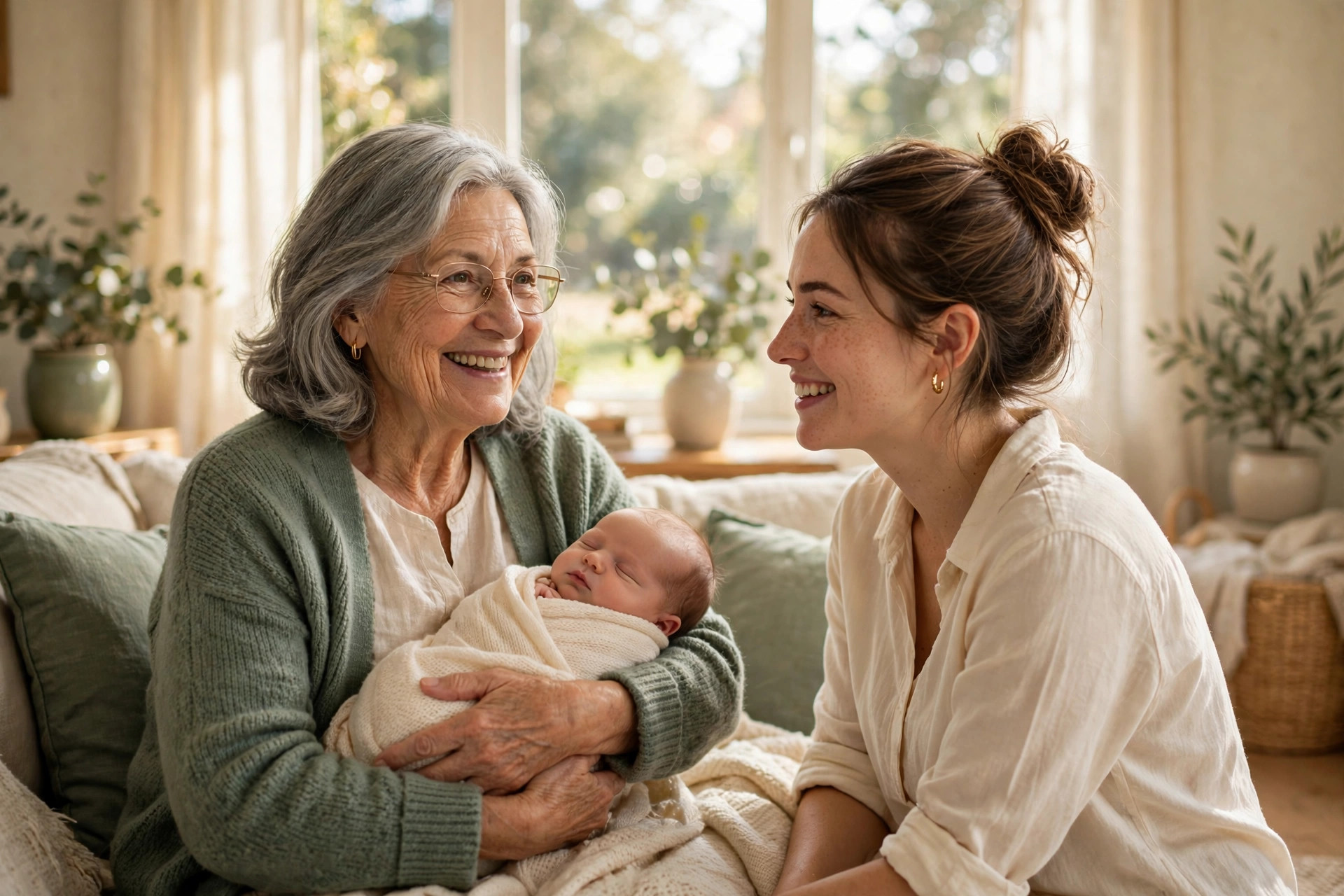
Your grandparents are the only people who can tell your baby two things nobody else can: what the world was like two generations back, and what your own mum or dad was like as a child. Thirty questions, asked a few at a time across the first year, are enough to keep those stories. This guide gives you the questions in six small groups, a way of asking that actually gets answers, and a plan for turning what they say into something your baby can read one day.
Why grandparents' stories matter for your baby
A baby arrives into a crowd of people who already love them. The grandparents in that crowd carry something nobody else has: the family's past, in their own voice. When researchers at Emory University asked children twenty simple questions about their family history, do you know where your grandparents grew up, do you know where your parents met, do you know the story of your birth, the children who knew more of those stories showed higher self-esteem and a stronger sense of control over their own lives. The paper puts it plainly: "Adolescents who report knowing more stories about their familial past show higher levels of emotional well-being, and also higher levels of identity achievement, even when controlling for general level of family functioning." The Emory Family Narratives Lab says the same thing in plainer words. Children who know more family history show higher self-esteem, fewer behaviour problems, and a stronger sense of self-efficacy.
None of that needs a perfect interview. It needs a few stories, told and kept. A grandparent who tells a baby's parent what the house smelled like on a Sunday, or what their own mother said when the phone rang, is handing the baby a past they can stand on later. The first year is the right time to start, because grandparents are around the baby more than they will ever be again, and because a new baby makes people want to talk about beginnings. You do not need a recorder and a plan. You need five questions and a pen.
How to ask so they actually talk
Most grandparents freeze when you ask for their life story. They wave it away. They say they have nothing to tell. The fix is small. Ask about one concrete thing, a kitchen, a car, a first job, the way somebody laughed. HandedDown, a family-history project, puts the rule in one line: "Each question is about one concrete thing: a kitchen, a car, a first job, the way somebody laughed. A small question gets a story. A big one, like 'what was your childhood like?', gets a summary." Our own journal says the same thing from the other side. Ask for her life story and she waves it away. Ask about the kitchen she grew up in, or the teacher she never forgot, and she talks for an hour.
Four habits make the asking work.
- One group per visit. Take five questions to a visit, not thirty. The question lists in this guide are built in groups of five for exactly this reason. One group, one cup of tea, and stop while it is still fun.
- Ask them separately when you can. Grandma and Grandpa lived the same days and remember them differently. The Memory Palace guide says it straight: "Ask both grandparents separately if you can. They often remember the same day in very different ways." Two versions of one day are a gift, not a problem.
- Let the answer wander. The question is a door, not a test. If the answer to "what did you cook?" turns into a story about a neighbour, follow the neighbour. The best stories in this guide's table are the ones nobody planned.
- Write it down the same day. Memory fades fast, even yours. One line and one photo is a complete entry. A date plus five words beats a beautiful page never written. Put the date on every answer, because years from now the date is the first thing you will want and the first thing you will have lost.
Skip anything that feels heavy. This is not a therapy session and not a school project. If a question lands wrong, move on. There are thirty here, and five good answers are a fine first year.
The 30 questions: six groups for baby's first year
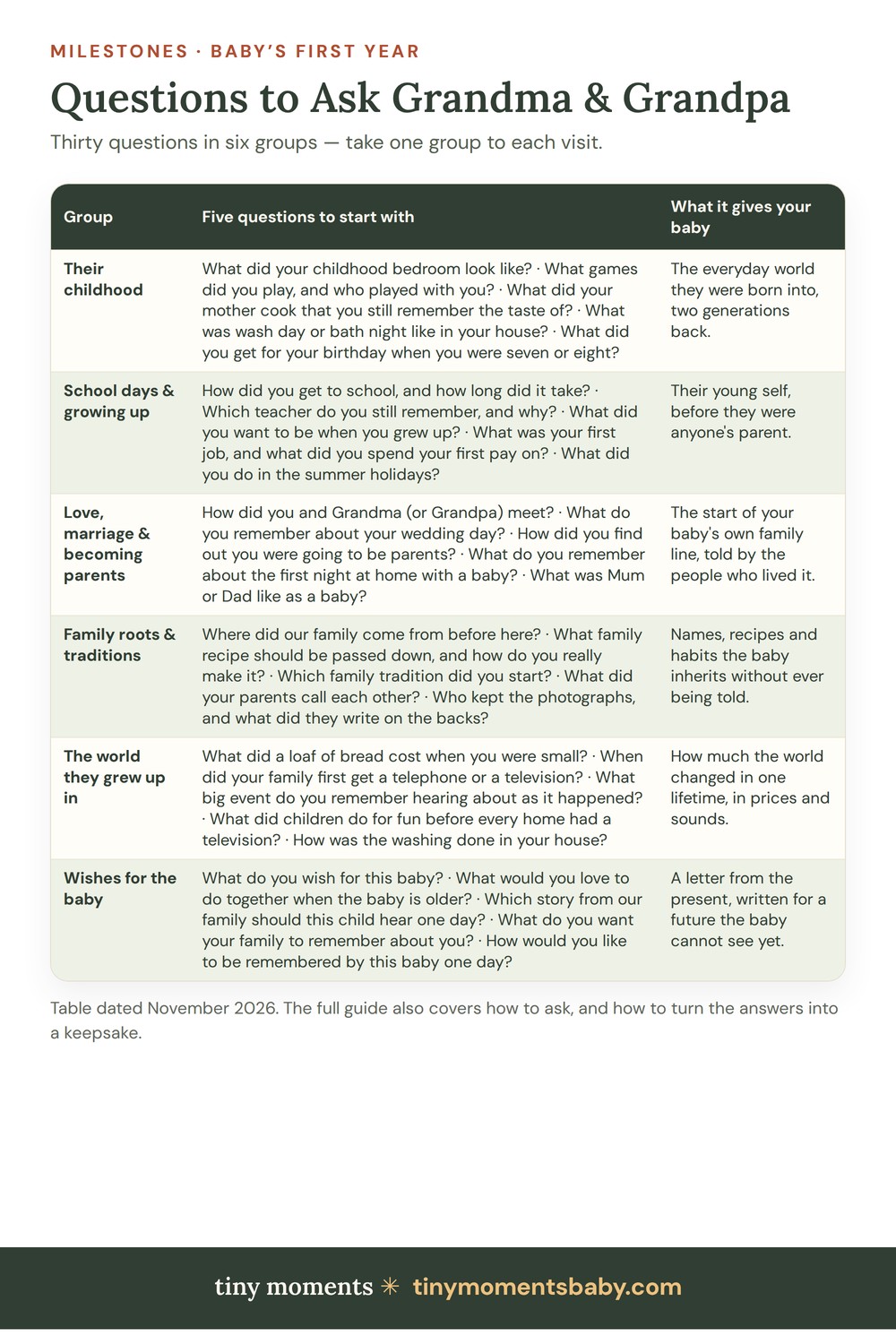
Thirty questions, in six groups of five. Take one group to each visit. The table is dated November 2026.
| Group | Five questions to start with | What it gives your baby |
|---|---|---|
| Their childhood | What did your childhood bedroom look like? · What games did you play, and who played with you? · What did your mother cook that you still remember the taste of? · What was wash day or bath night like in your house? · What did you get for your birthday when you were seven or eight? | The everyday world they were born into, two generations back. |
| School days & growing up | How did you get to school, and how long did it take? · Which teacher do you still remember, and why? · What did you want to be when you grew up? · What was your first job, and what did you spend your first pay on? · What did you do in the summer holidays? | Their young self, before they were anyone's parent. |
| Love, marriage & becoming parents | How did you and Grandma (or Grandpa) meet? · What do you remember about your wedding day? · How did you find out you were going to be parents? · What do you remember about the first night at home with a baby? · What was Mum or Dad like as a baby? | The start of your baby's own family line, told by the people who lived it. |
| Family roots & traditions | Where did our family come from before here? · What family recipe should be passed down, and how do you really make it? · Which family tradition did you start? · What did your parents call each other? · Who kept the photographs, and what did they write on the backs? | Names, recipes and habits the baby inherits without ever being told. |
| The world they grew up in | What did a loaf of bread cost when you were small? · When did your family first get a telephone or a television? · What big event do you remember hearing about as it happened? · What did children do for fun before every home had a television? · How was the washing done in your house? | How much the world changed in one lifetime, in prices and sounds. |
| Wishes for the baby | What do you wish for this baby? · What would you love to do together when the baby is older? · Which story from our family should this child hear one day? · What do you want your family to remember about you? · How would you like to be remembered by this baby one day? | A letter from the present, written for a future the baby cannot see yet. |
Tip: this table scrolls sideways on small screens.
Two notes on the table. First, the questions are written for one grandparent at a time. Where a question says Grandma, swap in Grandpa, Nana, Gigi, or whatever your family says. Second, the last group is the one to save for a quiet visit, not a busy one. "What do you wish for this baby?" is a short question with a long answer, and it deserves an afternoon of its own. If you only ever ask one group, ask that one.
A free card for Grandma, from the baby
Before the journal, try a small gift: free printable gift cards for the new grandma — a folded card, a flat 5×7 card and a Reasons We Love You card, each with a fillable name line for Grandma, Grandpa, Nana, Gigi or Grandparents. US Letter and A4, free by email.
Get the free Grandma card →Journal, notes app, or just remember: which fits your family?
Questions are only half the job. The other half is where the answers live. Four questions decide it: will you actually write it down? (a method you skip is worse than no method); who is doing the writing? (grandparents write best in large print with room; you write best on your phone); do you want something to hold in twenty years? (only paper gives you that); and how much time will you really give it? (one question a week is a pace most families keep).
| Option | Cost | Effort | What lasts | Best for |
|---|---|---|---|---|
| Guided journal (Tell Me Your Story) | $14.99 one-time, both editions | One question a week, in their handwriting | Two finished books, 100 answers each | Families who want the whole life story kept |
| Phone notes + voice memos | Free | Fast to capture, easy to lose | As long as the phone and the backup survive | Quick capture on the day, before it fades |
| A notebook by the sofa | A few dollars | Write after every visit | One handwritten book, if it survives the house | Parents who like writing by hand |
| Just asking, trusting memory | Free | Nothing to carry | Almost nothing, a year later | Nobody, honestly — use it only as a backup |
Comparison current as of November 2026. Our honest recommendation is the first row, and the reason is simple: a guided journal asks the questions for you, in the right order, one to a page, with room to write. Phone notes are the best companion to it, not a replacement. Record the conversation on your phone, then copy the best lines into the journal while the visit is still fresh. That pair, a recording and a book, is how answers survive from a visit into twenty years. More keepsake ideas live in our Milestones & Keepsakes section.
Turning the answers into a keepsake for baby
Answers in a phone note are not a keepsake yet. They become one when they land somewhere the baby will find them. The simplest finish takes a few minutes after each visit: write it down the same day, with the date on every answer, because the date is the first thing you will want later; keep the exact words where you can, their phrasing, not your summary, because their voice is the keepsake; add one photo to each answer, the house, the street, the wedding photo they pointed at, because a photo with a story beside it is worth ten photos alone; and give the answers a home, one place, not five, so the baby does not have to hunt for them in twenty years.
The home can be a journal, and a guided one makes this part easy: each edition of the Tell Me Your Story Journal ends with a letter to the grandchildren, and every question page carries a "Written on" date line, so the family will know exactly when each story was written down. Or the home can be the baby's own book. Our baby memory book guide works on the same rhythm, one line and one photo is a complete entry, and a page for the grandparents sits naturally beside the monthly pages. Either home works. What matters is that there is one home, and that the answers go there the same week they are told.
What if Grandma says she has nothing to tell?
She almost certainly will. It is the most common first answer, and it means nothing about how much she has to tell. The journal's own guidance says it plainly: the questions start small and concrete, the house she grew up in, the walk to school, and each page carries a short memory spark to get her started. The book's first pages set the rules: answer only what she enjoys, a short answer is a real answer, and there is no order and no deadline.
Three things help when the words will not come. Show her a photo. An old photograph, or an object with a story behind it, is the easiest way into a memory. Ask who is in it, and the story follows. Ask together. Fill it in as a family, writing down her words as she talks, instead of handing her a book and a pen. Let her skip. A skipped question is not a failure. It is a door left open for a later visit, when she is ready. Many families find the first answers are short, a sentence or two, and the later ones run long. That is how it should work. A short answer is a real answer.
Questions parents ask us
When is the best time to ask grandparents these questions?
Start now, in the baby's first year, while grandparents are around the baby most. Take one group of five to a visit, and stop while it is still fun. A new baby makes people want to talk about beginnings, and the first year gives you a dozen easy visits to spread the groups across.
Should I ask Grandma and Grandpa together or separately?
Separately, when you can. They lived the same days and remember them differently, and two versions of one day are a gift. Together works too, especially for the wishes group, where one answer often starts the other one talking. If you only get one sitting, do it together and write down who said what.
How do I record the answers?
Record the conversation on your phone, then write the best lines down the same day, with the date on every answer. A guided journal makes this easy: one question per page, a "Written on" date line on every page, and room to write at their own pace. Voice memos are the backup, not the home. The home is one book, in one place.
What if a grandparent has passed away, or lives far away?
Ask the family members who knew them. A parent, an aunt, an older cousin can answer many of these questions, and their answers count. For grandparents far away, the journal works by phone or video call just as well: ask one question, write down the answer while they talk, and post the book when a visit comes. The questions do not need a kitchen table. They need a voice and a pen.
Their stories, in their own handwriting
Tell Me Your Story Journal is two complete guided journals in one download, one written for Grandma, one written for Grandpa. Each asks 100 gentle questions across 12 chapters of a life, one question on every large-print page, with room to write at their own pace. Print it, bind it, give it, and get back a book no shop can sell you. Family tree, photo pages, recipe pages and a letter to the grandchildren inside each edition.
$14.99 one-time · both editions · instant download
Get both editions — $14.99 →Written by Sahinul Islam Laskar, founder of Tiny Moments
Sahinul runs Tiny Moments, a small independent studio making calm, practical printables and guides for new parents. He is not a medical professional: everything here is educational information drawn from published guidance (AAP, CDC) and official data (SSA) — never a substitute for your paediatrician's advice.
Keep reading
 MilestonesBaby Milestone Cards: How to Use Them (Photo Ideas by Month)How to use baby milestone cards: the 5-step method, a photo idea for every month of the first year, what to write on the back of each card, and an honest cards-vs-blanket-vs-app choice.
 MilestonesBaby Memory Book Printable: What to Record in Baby's First YearWhat to record in your baby's first year, month by month — the printable memory book table, a 10-minute routine, and a calm print-vs-digital choice.
 MilestonesBaby Milestones Chart 0–12 Months (Free Printable)The CDC checkpoints for 2, 4, 6, 9 and 12 months in one calm chart — what most babies do, and how to record every first.
 CelebrationsGender Reveal Ideas Beyond Pink-or-Blue SmokeTwelve gender reveal ideas beyond pink-or-blue smoke — cake cuts, balloon boxes, scratch-offs, songs and keepsakes — with a safety-first checklist and a choose-by-situation framework.
 Baby NamesOld-Fashioned Baby Names Coming Back: 40 Vintage PicksForty vintage names — back, coming back and still waiting — with meanings, pronunciations and honest US popularity.
Swipe sideways for more →
Sources & further reading: Fivush & Duke (Emory University) — “Do You Know…” The power of family history in adolescent identity and well-being · Emory Family Narratives Lab — Family Narratives · TBF Scrapbook — Questions to ask your grandparents, grandma or grandpa · The Memory Palace — Questions for grandparents meeting the new baby · HandedDown — Questions to ask your parents and grandparents · OhioHealth — 20 Questions for Kids to Ask Grandparents · Memowrite — 120+ Questions to Ask Your Grandparents About Their Life · FromBeyond — 30 Life Story Questions for Grandparents · Tiny Moments — Tell Me Your Story Journal (Grandma & Grandpa editions)
Educational information only, not medical advice.